Wednesday, August 17, 2011

If only the 300-pound propeller that went missing could talk

A converted rum-runner did service along the rugged Vancouver Island coast as a motor launch in the modest fleet maintained by the British Columbia Provincial Police. Photograph courtesy B.C. Archives.

By Tom Hawthorn
Special to The Globe and Mail
August 18, 2011

At dawn, Joseph Spears trundled downstairs to the home office, casting a glance into the front courtyard.

Something was amiss.

“That’s kind of strange,” he thought to himself. “There’s no propeller.”

Eleven years earlier, four burly loggers lugged a brass propeller into the yard on the waterfront in Horseshoe Bay, where it had rested ever since. Flowerpots were placed between the blades to brighten its appearance.

Joseph Spears
Mr. Spears, a lawyer, knew not to contaminate a crime scene, yet curiosity compelled him to take a closer look. The flowerpots had been moved and concrete pavers showed telltale scratch marks. The 136-kilogram (300-pound) propeller was gone.

Later in the day, the West Vancouver police issued a press release. “At 0822 hrs,” the department was “advised of a theft complaint.” Missing was a brass propeller. Estimated worth — $5,000.

So far, so ho-hum. Brass and copper items are purloined every day to be sold as scrap.

The police had one other detail.

The propeller came from a vessel “once owned by infamous Al Capone in the days of rum running back east.”

In the dog days of summer, the notion of a Capone connection generated plenty of local media coverage. The hunt was on for an artifact of Prohibition-era shoot-’em-ups.

The propellor had been scavenged from the Texada, a 28.3-metre (93-foot), wooden-hulled vessel that ran aground in August, 2000. The ship, owned by a forest services company, struck a rock in Dolomite Narrows on the south side of Burnaby Island in the Queen Charlottes (now Haida Gwaii).

As the tide went out, the vessel listed sharply to port. The accident site was part of a protected marine conservation area in the middle of Gwaii Haanas national park. The crew joined park wardens and contracted private operators to pump diesel fuel off the stricken vessel. After three weeks, a towing company hauled the Texada to Vancouver, where it was scrapped. Mr. Spears, who had represented a company involved in the salvage, wound up with the propeller.

The schooner was built in 1930 in the renowned shipyards of Shelburne, N.S., where it was outfitted with a modest, six-cylinder engine, standard for fishing vessels. The owner soon after registered it in Newfoundland, a British colony, at which time it was powered by a pair of 12-cylinder motors.
Flower pots decorated the propeller before the theft.
The refitting allowed Margaret S II to outrun police, or rival gangs, as it ferried a cargo of booze, not fish. Even after Prohibition ended in the United States, the rum-runner cruised from St. John’s to Bermuda. One researcher has found evidence the schooner transported 3,300 cases of liquor in a single month in 1934. The criminal gangs that profited from challenging the booze ban later sought to avoid taxes.

After being seized by the Dominion Government, the vessel was loaned to anglers and members of the New York Zoological Society (reminding one “unpleasantly of various Baltic Sea cargo boats”) before winding up on the West Coast in 1938. The rum-runner became the pride of the modest fleet of the British Columbia Provincial Police. In a Victoria shipyard, according to the historian R.G. Patterson, the hold was transformed into sleeping quarters for the crew with cells for five prisoners. An aft fuel tank was removed to make way for a sea-going courtroom billed as the world’s smallest (“a virtual broom closet,” according to one account).

Police Motor Launch No. 14 patrolled the rough waters surrounding Vancouver Island, pulling into isolated outports and reserves. After four years, the patrol vessel joined the Fishermen’s Reserve (the Gumboot Navy) of the Royal Canadian Navy under yet another name, HMCS Ripple. It spent the last three years of the war with an eye out for Japanese submarines.

In 1945, the government sold the boat to B.C. Packers Limited, which gave it yet another refit, this time to aid in fish packing. The company also gave the vessel the name it would carry to the scrap yard decades later.

It was the propeller of the ex-Margaret S II, the ex-P.M.L. #14, the ex-HMCS Ripple, and the ex-Texada that wound up in the yard of 6438 Bay St. in West Vancouver. Next door is the Troller Pub, a fitting neighbour for a rum-runner’s prop.

Yet, the evidence of a Capone connection is slim. In an insurance dispute involving the Texada, John Hargrave, a prothonotary of the Federal Court of Canada, issued an order in which he described having been shown the boat many years earlier. A marine engineer “showed me a cabin with a diagonal row of holes in the lining,” telling him that “they were machine gun bullet holes and that he knew for certain she had been a rum runner, owned by Al Capone.”

The Chicago mobster went to prison on tax evasion charges in 1931, the same year in which the vessel would likely have been first used in a criminal enterprise.

The West Vancouver police quickly recovered the prop, thanks in part to media coverage fueled by the association with a notorious gangster.

A "broom closet" courtroom was placed in the aft of Police Motor Launch No. 14, commanded by the British Columbia Provincial Police. The converted rum-runner is believed to have once been owned by the notorious gangster Al Capone. 

The Texada rests on a rock after running aground in a national park in what is now Haida Gwaii.

Monday, August 15, 2011

The professor who cracks the secrets of the spies

The historian David Stafford has retired to Victoria. He has written extensively on special operations in wartime. Photograph by Chad Hipolito for the Globe and Mail.

By Tom Hawthorn
Special to The Globe and Mail
August 15, 2011

VICTORIA

Spies have their secrets and they take them to the grave.

It is David Stafford’s mission to uncover those mysteries, to shine light on the shadowy world of wartime intelligence operations.

He pursues his quarry not by cloak-and-dagger means, but through diligent work while sitting at reading tables in dusty archives. Documents tell a story, but only part of one, and not always truthfully. It takes a lifetime of research and an insider’s knowledge of bureaucracy to ferret out truths hidden by those trained in stealth.

The world of Churchill and Hitler, of spy craft and secret agents, of mysterious places known as Camp X where operatives were trained in The Silent Game, as he titled one of his books, seems all the more wild and adventurous considering Mr. Stafford’s own daily routines.

At 69, he can be found puttering in a garden in Victoria’s tony Rockland neighbourhood, a white-haired, avuncular figure whose native Geordie accent has been softened after many years in Canada.

His latest book was released earlier this year with the satisfying title Mission Accomplished. In some ways, that is the case for Mr. Stafford, too, who is now taking a well-earned sabbatical.


The British Cabinet Office commissioned the work, an official history of actions by Special Operations Executive in Italy from 1943 to the end of the Second World War. SOE was the force established for espionage, sabotage and subversion in lands of German occupation. As Churchill memorably ordered, their job was to “set Europe ablaze.”

Written to be enjoyed by a general audience, Mr. Stafford also took as his responsibility to provide for scholars “a first sketch” of the secret war on the peninsula, seeding the ground of his research with footnotes to encourage further exploration. “I’ve given them al the signposts,” he said.

One of the more fascinating details in the book regards the loyalties of Italian military intelligence following the overthrow of Mussolini. They opposed the German occupation of the north of the country.

“They worked closely with the Allies,” Mr. Stafford said. “They had networks behind the lines. They had a lot of wireless operators who were then trained by SOE as wireless operators for SOE.”

David Stafford
Their presence added a conservative, Royalist force to an Italian resistance popularly regarded as being dominated by left-wing anti-fascists.

Mr. Stafford prefers to be known as an historian of war rather than a military historian. In his other recent books, Ten Days to D-Day and Endgame, 1945, both popular histories with rigorous scholarship that earned favourable reviews, he tells grand narratives through the experiences of individual soldiers and civilians.

More than six decades after the end of the Second World War, the appetite for histories of that conflagration remains unsatisfied. The groaning shelf of books on Churchill, to which Mr. Stafford has contributed two titles, remains a genre of its own.

Why has the interest persisted?

“Naziism was an unequivocal evil, not much doubt about that,” Mr. Stafford said. “It has a black-and-white simplicity about it. We live in rather grey and uncertain and confused times now. I think there’s a yearning for certainty. We can look at that war and not have qualms at being involved.

“We can agree that while the costs were dreadful, they were on the whole worthwhile.”

The ranks of surviving veterans dwindles daily, as time exacts its toll. With each death, a historian mourns the loss of a fragment of the story of the war.

“I regret so many of their stories will not survive,” he said. “A lot of the histories will die with them.”

Born at Newcastle-on-Tyne in 1942, Mr. Stafford gained his doctorate while working for the British Foreign Office. He abandoned a career in diplomacy for one in academia, taking a position at the University of Victoria in 1970, where he would remain for 14 years. While here, he interviewed nine veterans about their role in clandestine operations, a fanciful description for old-fashioned spying. The professor donated his tapes to the university library and the interviews can now be heard online.

While finishing an earlier book on SOE, his father, a university mathematics lecturer, whom he knew had served as a meteorologist with the Royal Air Force, admitted to a minor role in special operations while posted in Ceylon (now Sri Lanka). Norman Stafford was responsible for preparing weather forecasts for flights in which agents were to be parachuted behind Japanese lines.

His father kept his secret until shortly before his own death. Now a son seeks to revive another lost tale from the archives.

Tuesday, August 9, 2011

O, Habitat, what a time we had

Workers are dismantling the wharf at Jericho Beach, a final physical reminder of the Habitat Forum in 1976. Lindsay Brown photograph.

By Tom Hawthorn
Special to The Globe and Mail
August 10, 2011

The battle of Jericho is over and the wharf is tumbling down.

Workers are dismantling a wooden structure that juts over the shoreline at Jericho Beach on Vancouver’s west side. Pilings, soaked in creosote, will be removed and the beach restored to a more natural setting.

The decorative metal railings that lined the wharf, against which lovers and sightseers leaned while gazing onto the waters of English Bay, are being stacked for future use, possibly in Stanley Park.

The railing once prevented pedestrians from falling off the Lions Gate Bridge. The bridge had been undergoing a refurbishment and the railings were no longer needed. A visionary named Alan Clapp knew how to use them.

Thirty-five years ago, a sleepy and rough-edged port city played host to the inaugural United Nations Conference on Human Settlements. It was Vancouver’s reluctant debut on the world stage. Local politicians balked at the policing expense, fretting about the violence of the Middle East finding expression in a Pacific city, puzzling why a conference on sheltering the world’s poor was being held in wealthy Canada.

While government officials and other bigwigs met at swank downtown hotels, Mr. Clapp, a television producer with a reputation as an “ideas man,” organized an alternative conference on the site of an old Royal Canadian Air Force seaplane base. A persuasive and indefatigable go-getter, Mr. Clapp negotiated use of the site and gained modest financial support from an NDP provincial government and its Social Credit successor.

Cavernous aircraft hangars left over from the Second World War were modified to resemble native longhouses. Architects designed innovative seating in the hangar used as a plenary hall, as giant wooden blocks were stacked like a giant Jenga game. A massive banner covered the entire ceiling.

Horses hauled driftwood off the adjacent beach. Wood was milled on site. The artist Bill Reid created a magnificent mural on the exterior wall of one of the hangars. Hundreds of school children volunteered, helping to keep the area clean. Instead of being discarded, the old bridge railings were salvaged for use on the wharf, a scenic centerpiece.

The Habitat Forum ran in conjunction with the official meetings. It was an independent, grassroots alternative with open doors to all. Habitat attracted such luminaries as Mother Teresa, the anthropologist Margaret Mead, and the futurist Buckminster Fuller, whose geodesic dome had been such a hit at Expo 67. Margaret Trudeau, the prime minister’s wife, joined others in hauling water to the site by pail to demonstrate the daily difficulty so many of the world’s poor faced in simply providing a clean and safe drinking supply.

Habitat was chaotic and creative, an admirable attempt to ensure the public could have a voice in tackling the problems of poverty and sustainability.

For some who attended, such as Lindsay Brown, then a 13-year-old high school student, the week-long gathering was an unforgettable experience.

“It was an exciting environment. It had this strongly Utopian feel,” she said.

“I was devastated when it was over. I went back to school and Vancouver went back to how it had always been.”

She long held a nostalgic feel for the gathering, an emotion she assumed was unique to her. Two years ago, she began researching a book about Habitat, some of which can be found on her blog. She discovered the conference had a lingering hold on those who attended.

“It had been formative for a lot of people who then went on to take a more global standpoint in their own work,” she said.

Unlike Expo 86 or last year’s Winter Olympics, which were commercial and tidy, the Habitat gathering did not depend on corporate sponsorship and so was more freewheeling in spirit. The site had a carnival feel. Though participants grappled with big problems, Ms. Brown remembers a spirit of “casualness” and of “hopefulness.”

“There was not a lot of security and you could mix with people from all over the world,” she said. “It felt like a microcosm of the planet.”

The United Nation’s department responsible for settlement issues is still known as UN Habitat and its founding document is The Vancouver Declaration, an unrealized blueprint.

The hangars are now long gone. The wharf has been a last physical reminder of the week 35 years ago when the world came calling. A driftwood sculpture created by Bernard Thor for the event can be found in the adjacent park. It now includes a plaque hailing “a moment in time when people came together to think of their neighbour.”

Margaret Trudeau (left) joins Margaret Mead at Habitat Forum in Vancouver in 1976, a chaotic, colourful gathering that tried to tackle the problems of shelter and poverty for the world's people.


A word about Jericho Beach

The beach’s Biblical name has a more prosaic origin. Long the site of an aboriginal village known as Ee’yullmough, the original residents were shunted aside with the arrival of Europeans. Jeremiah (Jerry) Rogers, whose axeman fell the giant trees of Point Grey and Kitsilano, established a camp and spar-cutting operation at what became known as Jerry’s Cove. Over time, the name mashed into Jericho.


The construction of the alternative conference known as Habitat Forum lured an eclectic crowd to the shores of English Bay at Jericho Beach.

Monday, August 8, 2011

Globe trekking author Bernie Howgate has been around

Bernie Howgate, a self-published author who sells his books door to door, holds a copy of his latest work while working the streets of Victoria. Photograph by Chad Hipolito for the Globe and Mail.

By Tom Hawthorn
Special to The Globe and Mail
August 8, 2011

VICTORIA

The doorbell rings. On the porch stands a lean man with a lined face framed by long, stringy hair.

He looks like a skinnier, shorter version of the comedian Billy Connolly.

He introduces himself in an accent betraying Yorkshire roots. Bernie Howgate is going door to door selling his self-published book, Zen and the Art of Paddling. He begins his pitch by citing a radio interview and holds in his hands a laminated card of newspaper clippings.

Peddlers do not do well at my front door. I buy neither God nor Greenpeace on my stoop. (I make an exception for Girl Guide cookies.)

Mr. Howgate senses a sale is not in the works and begins to depart. I ask again for his name. He holds up the card.

“I can write it down for you if you’d like,” he says in a tone midway between weary and hostile.

We have not got off to a good start.

Mr. Howgate has been wandering the globe as a solo traveler for more than three decades. Each outdoor adventure concludes with the writing of a memoir, which he then sells to generate funds for the next trek.

He has been on the road since 1980, when a two-month bicycling holiday became an eight-year global odyssey that led to his first title, Tales of a Travelling Man.

He has since cycled from Victoria across Canada on a rickshaw (Newfie or Bust), snowshoed along the forbidden Atlantic shore in winter (Journey Through Labrador), and kayaked the waters from Toronto to Goose Bay (A Lazy Day in Summer).

Bernie Howgate in the 1980s.
“I’ve (been) bitten, stung, battered and bruised by every winged creature known to man,” Mr. Howgate writes, “but nothing comes close to the Labrador mosquito when it’s on an eating frenzy between storms.”

He has traversed vast expanses of this land, enjoying along the way the hospitality of strangers, such as Eric West, of Ladle Cove, on Newfoundland’s Notre Dame Bay, who once invited Mr. Howgate for supper.

“People are basically good and they want to meet visitors,” Mr. West, a guitarist, told CBC Radio some years ago, “particularly ones as strange as Bernie.”

The peripatetic writer gained newspaper notice in 1979 when he motored the isolated Dempster Highway as part of a 20,000-kilometre continental drive in an eight-year-old car. He endured three blowouts, a broken windshield and a ruined muffler.

The adventurer maintains a website on which he tells his story and offers to speak to school classes for a fee. A Toronto newspaper once witnessed his slideshow presentation to a junior middle school and praised a comic delivery reminiscent of Monty Python.

The books lack in professionalism — spelling and grammatical errors abound. The writing offers an unvarnished monologue about a lonely sojourn delivered in a voice sometimes humourous, sometimes sarcastic, often ribald.

“No Steinbeck,” critiques the Hamilton Spectator, “but he’s no bum either.”

A few days after he exits my porch, we meet at an unpretentious pub on Cook Street in mid-afternoon. If he recognizes me, he does not let on. He has been pounding the street for hours, as he does seven days a week. He finds Victorians to be reserved and so polite about not buying a book that he loses precious time waiting for the formal rejection, a proposition that bothers him not in the least.

“I’m old enough. I’m not going to burst into tears,” he said.

“If you can’t take rejection, you’re in the wrong (expletive) business.”

The sound of his homeland is still on his tongue, though he has lived in Canada for nearly four decades. The son of a cook and textile worker of Irish ancestry from Birkenshaw, West Yorkshire, he came to Canada as a young man, finding work as a design draftsman for an engineering firm in Toronto. He soon after hit the road and has not ever left.

Mr. Howgate, 62, wears a crisp, clean shirt and carries his books and his laminated clippings in a backpack. He drives a dusty Chevrolet Suburban, joining other sojourners along the Wal-Mart trail, where vast parking lots offer inexpensive accommodation. His itinerary this month includes a circle route from Victoria to Nanaimo, Comox, Powell River and Vancouver.

First, though, this book tinker revisited a promising street in Victoria’s Gonzales neighbourhood. He unwittingly returned to a house where he had earlier been unsuccessful.

The second visit was, improbably, even less fruitful.

My dog nipped him.

Thursday, August 4, 2011

Conquering Canada's open road in a ’26 Bentley

Robin Hine poses in a motoring cap in Halifax after his Bentley arrived by freighter from England. He drove the open-air vehicle from Cape Spear in Newfoundland to Mile Zero on Vancouver Island this summer. Adrien Vezcan photograph for Canadian Press.

By Tom Hawthorn
Special to The Globe and Mail
August 4, 2011

VICTORIA

Robin Hine slowly rolled his 1926 Bentley towards a frothy foam until the wheels dipped into the chill waters of the Atlantic Ocean.

With his car baptised at Cape Spear, Newfoundland, the continent’s easternmost point, Mr. Hine then pointed his roadster in the direction of British Columbia.

“I’ve dreamt about driving across Canada since I was a boy,” he said.

Why?

“To see my home country. To see the land and the people.”

The 49-year-old carpenter was born in Victoria, moving to England with his family at age 14. He returned to his homeland four years ago and, in late June, began a journey for which he had planned a lifetime.

His English grandfather, a man known as The Governor and who worked for Lloyd’s, the insurance company, purchased the car for £90 in the depths of the Depression. It has been in family hands ever since. Mr. Hine took possession from his father 14 years ago, but left the vehicle behind in the village of Sherington in north Buckinghamshire, near Milton Keynes, when he returned to Canada.

In late June, the right-hand drive Bentley, bearing plate RM 2586, arrived in a crate on the Halifax waterfront after a week-long voyage from Liverpool aboard the Atlantic Cartier.

“We pushed ’er out, filled ’er with gas and water, pushed the button and off she went straight away,” Mr. Hine said. “Burst into life!”

Joined by his friend, Neil Stephenson, Mr. Hine left for Newfoundland to begin a cross-continental odyssey.

He is not the first in this vast land to succumb to the lure of trying to conquer the open road. In 1912, an automotive enthusiast and writer named Thomas Wilby, accompanied by driver and mechanic Jack Haney, left Halifax in a 35-horsepower REO touring car. In those days, newspapers still referred to the vehicles as “devil wagons” and “stink wagons.”
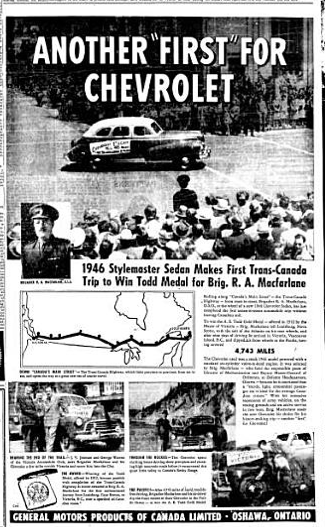
Newspaper ad touts Chevy in 1946.

The pair sought to drive all the way to Victoria, where the local automobile association offered a gold medal to the first motorist to cross Canada. The prize was sponsored by A.E. (Bert) Todd, the son of a successful salmon canner. Good Roads Todd, as he became known, had honeymooned by driving his teenaged bride from Tijuana, Mexico, north to Vancouver, a stunt to promote the building of a Pacific Highway. (Such a route was completed in 1923, billed as the longest paved stretch of road in the world at that time.)

Wilby and Haney arrived in Victoria after 51 days, but did not get the medal as they had shipped the vehicle by tugboat and rail through the worst of Northern Ontario’s expanse of rock and muskeg. Even the flat prairie offered challenges. As the mechanic noted in his diary after leaving Moose Jaw, Sask.: “Rough going over trails, ploughed ground and gopher holes.” Their journey was re-enacted in 1997, the adventure recorded in a book by John Nicol titled, The All-Red Route.

The Todd medal would not be claimed for 34 years, when Brigadier R.A. Macfarlane and Squadron Leader Ken MacGillivray needed just nine days to motor from Cape Breton Island to Vancouver Island. (The pair departed from Louisburg, N.S. Newfoundland would not join the Dominion until 1949.) They made the trip in a new 1946 Chevrolet Stylemaster sedan powered by a six-cylinder, valve-in-head engine.

In 1960, three CBC Radio technicians drove a white Chevrolet Impala sedan from St. John’s, Nfld., to Victoria. The car was outfitted with heavy-duty shocks and springs, as well as a larger battery to power a Magnecorder tape-editing machine. The men made 23 broadcasts from 23 towns before arriving in the B.C. capital, where they presented a flask of water from the Atlantic Ocean to mayor Percy Scurrah.

The Trans-Canada Highway was not completed for another two years. Prime Minister John Diefenbaker was afforded the honour of tamping the last stretch of pavement at Rogers Pass in Glacier National Park.

Mr. Hine’s Bentley chugged past that very spot, nearing the end of a long journey. After 18 days, he arrived at Mile Zero at the foot of Douglas Street before driving to Cattle Point, where he eased the tires into salt water feeding into the Pacific Ocean. The odometer read 5,456 miles (8,780.5 kilometres).

“I’m disappointed it’s over,” he said, his face bronzed by days spent in an open-air vehicle. “I’ve got the bug.”

On Wednesday, the trusty Bentley was in the garage, wheels off, accordion hood opened. It is being inspected for approval for a B.C. license plate, after which Mr. Hine will drive it in daily use. He so enjoyed his east-to-west trek he is now considering an attempt the other way.

Behind the wheel, he is a one-man antique roadshow.

A trio of CBC Radio technicians delivered nightly reports as they motored across Canada in 1960 in a white Chevrolet Impala. The Trans-Canada Highway was not completed for another two years.

Exploring one of the best kept secrets in Victoria


Built as a modest family home on acreage on the Gorge waterway in Victoria, Point Ellice House had many additions over the years. Even today, some mistake it for a private bed and breakfast.


By Tom Hawthorn
Boulevard Magazine
August, 2011

The historic Point Ellice House can be found on Pleasant Street. A surrounding heritage garden showcases roses and lilacs and hollyhocks. The grounds offer two leafy acres of bucolic pleasures, an oasis set amid the hubbub of a bustling city.

The aged Italianate-style house was to get some needed repairs over the summer. The plan was to fix woodwork before an overdue paint job gave the home a refreshed appearance in time for a 150th anniversary celebration to be held later this month.

It will take some doing to ensure this historic gem survives to mark its 160th birthday.

Point Ellice House is one of the best-kept secrets in the capital district. Some assume it is a private bed and breakfast. In fact, volunteers labour hard to keep the national historic site in prime condition. For a tourist city offering no shortage of attractions, the home and gardens are too often overlooked. The spectacular 55 acres of the Butchart Gardens are far larger and more fantastic; Craigdarroch Castle offers a hint of turn-of-the-century life in a fairy-tale setting just a short uphill stroll from downtown.

A more modest venture, Point Ellice House charges just $6 admission, including an audio tour. A full luncheon tea with soup, savories, and sweets served in the garden costs $25. The tea includes a tour. Such prices are on the low end.

Page through the guestbook and the comments are filled with praise: “Lovely”; “Beautiful as always”; “I like that it feels lived in, not museumified.” But the most telling statement is: “I’ve lived here all my life and I never visited.”

More than three in four visitors come from outside the country, attracted by favourable online notices and websites extolling one of the continent’s largest collections of Victoriana. Locals seem reluctant to visit. The house suffers as a destination in part because it is surrounded by industrial lands and such neighbours as a gravel retailer, a window-making factory, and an auto upholsterer. The drive along nearby Bay Street offers little promise of a return to a time when Queen Victoria’s namesake city was a far-off outpost in an empire covering much of the globe.

Built in 1861, the original waterfront cottage was purchased by Peter O’Reilly for $2,500 in 1867, the same year in which four British colonies on the other side of the continent joined a Confederation to be called Canada. Born in Ireland, O’Reilly came to British Columbia as a stipendiary magistrate at Fort Langley, later serving as a gold commissioner in the Cariboo.

In Victoria, he married Caroline Trutch, the sister of the man who became the province’s first lieutenant-governor. Their graceful home on the banks of the Gorge waterway was expanded over the years. A number of outbuildings were also built. Tennis and croquet were played on the expansive lawns. Although O’Reilly originally opposed British Columbia joining Confederation, he later changed his position and, in the summer of 1886, invited Prime Minister John A. Macdonald and his wife to the house for a gala party.

The O’Reilly home became a gathering place for the city’s social elite, as well as a favourite destination for young Royal Navy officers stationed at the nearby base at Esquimalt. One of the lures was the vivacious presence of young Kathleen O’Reilly, among whose suitors could be counted Robert Scott, later to gain worldwide fame as an explorer whose exploits were depicted in the movie, Scott of the Antarctic.

The house remained in family hands until the third generation sold it to the province in 1975. With the home came thousands of household items — a harp, tea services, writing desks, board games, kitchen utensils, silk taffeta neckties, porcelain foot warmers.

The house is owned by the provincial government and managed by the non-profit Point Ellice House Preservation Society. A big birthday party will be held on August 21 when singers and dancers will perform on the lawns. An old-fashioned egg-and-spoon race will be conducted for children. Visitors will be able to consult with experts in gardening and military history.

If the industrial surroundings seem off-putting for a visit, here’s a suggestion. Hop on a harbour ferry downtown and ride to the Point Ellice House dock along the harbour waters. These, too, were once despoiled by industry, but have since been reclaimed. Here’s hoping an historic house survives as a refuge and a reminder of the city’s earliest days.

A tea party on the expansive lawns, as shown in an undated photograph from the BC Archives (H-06661). The home featured grass tennis courts and a lawn for croquet. It now boasts a glorious garden.

Tuesday, August 2, 2011

Preserving a modernist gem

The Victoria Trend House, designed by John Di Castri, is a masterpiece of modernist vision. Built in 1954, the rear floor-to-ceiling plate-glass windows offer spectacular views of the Sooke Hills.

By Tom Hawthorn
Special to The Globe and Mail
August 2, 2011

VICTORIA

For fun, Stephen Winn and Sandi Miller enjoy motoring past Victoria’s small stock of modernist homes.

They are the kind of people who pore over copies of Modernism and Atomic Ranch magazines, delighting in the futuristic designs of objects and buildings.

Two years ago, with a second son on the way, they began a hunt for a new home. They hoped to obtain a mid-century marvel of their own, but knew the odds were long.

One night while trolling new listings on the Internet, Mr. Winn stumbled across their dream house. They toured the residence the following day, put in an offer, negotiated overnight, and within 48 hours owned it.

“We were ecstatic. We couldn’t believe our luck,” Mr. Winn said the other day.

What was the attraction?

“It has a uniqueness you don’t really see anywhere else.”

On its completion in 1954, the building was described in a magazine article as “the most talked-about house in B.C.” The mayor cut the ribbon and 35,000 people toured through the showcase home.

To this day, the house attracts passersby and looky-loos, as well as fellow disciples of modernist architecture.

To them, the house is a futuristic vision as sleek as a jet-age aircraft.

To those immune to the charms of the genre, it is a monstrosity looking like the crash site of a U.F.O.

The one-story house boasts a dual roof line — a flat roof extends into the house with clerestory windows above. A large masonry chimney slices into the roof, giving the appearance of a bisected jet tail. On the side of the house away from the street, plate-glass windows extend from floor to ceiling, offering spectacular views of the Sooke Hills and the snow-capped Olympic Mountains.

The interior floor plan is a polygon, eliminating dark hallways and making the most of an open-plan living and dining area. The floors and walls are wooden, as is the ceiling, which is composed of red cedar shiplap planks.

Most of the original interior detailing remains untouched even after six decades, though a large brick fireplace with copper hood had been resurfaced with slate rock.
John Di Castri

As well, earlier owners expanded the original 825-square-foot interior by adding a sunroom and other rooms. The current owners would like to eventually restore the building to its original condition.

The house, at 3516 Richmond Rd. in Saanich, was built as one of a series of Trend Houses commissioned to showcase softwood lumber from B.C. The 11 promotional Trend Houses caused a sensation, with hundreds of thousands of Canadians touring modernist designs outfitted with the latest furnishings from Eaton’s and electrical appliances from Canadian General Electric.

The Victoria Trend House, the smallest of the series, was designed by John Di Castri, a local architect who studied under Bruce Goff, an American often described as fearless for his wholly original creations. Mr. Di Castri brought to Victoria his Modernist ideals, changing the face of a city dominated to this day by arts-and-crafts bungalows, Samuel Maclure’s Tudor Revival mansions, and Francis Rattenbury’s monumental Inner Harbour bookends of the Romanesque Legislature and the chateau-style Empress Hotel.

The first resident of the Trend House was Gwen Cash, a pioneering woman reporter who wrote about the Doukhobors, the painter Emily Carr and the occultist known as Brother XII. In a recent blog post at Every House Has a Story, the Vancouver writer Eve Lazarus quotes Cash’s description of those who did not appreciate the design: “Like modern painting it was something that they couldn’t understand.”

The current owners — a homemaker and a negotiator with the provincial aboriginal relations and reconciliation ministry — feel they they have inherited responsibility for preserving a visionary’s masterpiece. Mr. Di Castri died in 2005.

“We see ourselves as stewards of a remarkable piece of architecture,” Mr. Winn said.

The couple are replanting the garden and envision a future day when a tour of the city’s modernist gems will include a pilgrimage to a house Mr. Winn considers “a part of Canada’s architectural history that is not as well known as it should be.”

The desire to preserve what they consider a treasure is worthy of praise. Five years ago, the first of the Trend Houses, built in Toronto, was torn down shortly after the death of its only owner. Earlier this year, the Trend House in suburban Beaconsfield, Que., outside Montreal, was razed. The nine that remain are testaments to a hopeful age when the future seemed full of possibility.

A sketch of the future house by architect John Di Castri. The pioneering woman journalist Gwen Cash was the first resident.

An undated photograph of the Victoria Trend House, one of 11 constructed across Canada to highlight B.C. softwood lumber products. The homes were outfitted in the latest interior fashions by Eaton's. About 35,000 visitors toured this house before the owner took possession.


A page from a colourful brochure showing the floor plan of the Victoria Trend House. At just 825 square feet, the layout makes the most of an open-space living and dining room area. Image courtesy the Michael Kurtz collection.