Showing posts with label Olympics. Show all posts

Sunday, February 12, 2012

90-year-old tells the tales of women basketball legends

Kay (née MacRitchie) MacBeth of Comox is one of only two living members of the legendary Edmonton Grads basketball team. Mrs. MacBeth plays baritone ukulele with the Heartstrings group. Erin Wallis photograph for the Globe and Mail.

By Tom Hawthorn
Special to The Globe and Mail
January 30, 2012

VICTORIA

Kay MacBeth takes pills for high-blood pressure and pushes a walker to get around after fracturing her pelvis. She drives her own car and on Wednesdays can be found practicing with the Heartstrings, the Evergreen Seniors Club string band for which she strums baritone ukulele.

“I don’t know how much longer I’m going to play,” she said. “It’s getting a bit too much for me to drive that thing around, to get in the car and get my walker out.”

Time eventually denies us our greatest pleasures.

MacBeth has been a widow now for 15 years. She long ago gave up sports, even golf, a rare activity in which skill can compensate for the ravages of advanced age.

More than seven decades ago, when she was a fresh-faced schoolgirl graduate in Edmonton, she was invited to join the storied Edmonton Grads, the greatest women’s basketball team the world has ever seen.

The Grads played more than 400 official games, losing just 20, according to M. Ann Hall’s definitive account of the team, The Grads are Playing Tonight!, published recently by the University of Alberta Press.

From 1922, when the Grads first won the Dominion championship, until 1940, when the club disbanded, the Grads used just 38 players. That roster is now down to just two survivors — Edith (née Stone) Sutton, 101, of Edmonton, and Mrs. MacBeth, 90, of Comox.

Young Kay MacRitchie, as she was known in 1939, leapfrogged from a junior team to the Grads, becoming the first Grad not to first compete with the Gradettes feeder team, according to the new book. The spectacular rookie worried about how her new teammates and the overlooked Gradettes would react.

“I was only 17,” she recalled. “I felt they’d be angry at me, because they’d played for quite a few years. I was excited, of course, but I didn’t show it. I was the youngest. The next closest to me was five years older. I was scared to say anything, or do anything, but I gave it all I had when it came time to play.”

She had grown up playing dodgeball in Saskatchewan and only learned basketball in Grade 10.

She developed a sharpshooter one-handed shot, but Grads coach J. Percy Page, who was soon to be elected to the Alberta Legislature and later served as lieutenant general, thought it unladylike to use anything but a two-handed shot.

“I was fast and I was a better dribbler than most,” she said. “I called myself the Court Master. I’d rather make a pass than take a shot.”

Unmarried, still living at home while working as a government clerk, she helped the Grads continue their enviable record as holders of the Underwood International Trophy. The cup, sponsored by a typewriter company, pitted Canada’s best against teams from the United States. In Mrs. MacBeth’s two seasons, the Grads defeated challengers from Chicago; Cleveland; St. Louis; Des Moines, Iowa; and, Wichita, Kan.

The Grads won their final Canadian championship in May, 1940, when low attendance and the demands of the war caused the amateur club to cease operations.

When her parents moved to Vancouver, she went with them to join the local Hedlunds basketball team for a few seasons, while also playing softball in summer.

In 1946, she married longtime beau Ross MacBeth, who had spent four years overseas as a Royal Canadian Air Force pilot. The pending marriage forced her to turn down a chance to play semiprofessional baseball in Arkansas. She raised a family and settled in the picturesque Comox Valley on Vancouver Island.

Over the years, the feats of the amazing Grads faded from memory. Few remember a team once heralded for many years as world champions.

“When I went to Edmonton in ’33, everybody knew the Grads,” she said. “Hardly anyone knows them now.”

The wonderful new book by Ms. Hall, emeritus professor at the University of Alberta, provides an informative and richly detailed account of the women who were sports pioneers. It is authoritative and deserving of a wide readership.

The Grads exhibited their prowess as far afield as Europe decades before women’s basketball debuted at the 1976 Olympic Games at Montreal.

Just a few years ago, the surviving alumni numbered enough to field a team. Among them was Helen (née Northup) Alexander, nicknamed Peewee by teammates for her 5-foot-2 stature, Lilliputian by basketball standards. A longtime resident of Sidney, she died in 2009, aged 93.

“A good little player,” Mrs. MacBeth said. “One of the smarter ones.”

The most recent to exit life’s parquet floor is Helen (née Stone) Stewart, who died in Vancouver in June, aged 101. It is now the duty of her twin sister, Edith, and Mrs. MacBeth to act as witnesses for the greatness of the Grads.

It is not a responsibility without frustrations.

“When anyone phones me I feel stupid because I don’t know what happened way back in the Twenties,” said Mrs. MacBeth, who became a nonagenarian last week. “They expect me to know all that.”

Mrs. MacBeth was the penultimate player to join the Grads, a teenager among seasoned veterans who’d lived the team’s previous glories. They are gone now and it is left to a rookie to tell the stories of departed legends.

Thursday, September 22, 2011

Olympian who overcame the odds now seeks a final turn with the torch

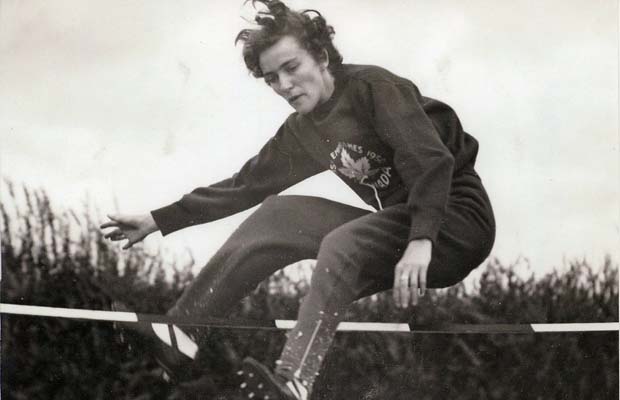
Shirley Gordon (later Olafsson) developed an unorthodox style of a scissor leg-kick to compete in the high jump. Born with a defect to her left foot, she needed to take off and land on her right. She represented Canada at the 1948 Olympics in London.

By Tom Hawthorn
Special to The Globe and Mail
September 22, 2011

To appreciate Shirley Gordon Olafsson’s athletic career, you need to know this statistic — her right shoe is size 9½, her left 5½.

She was born with a deformed foot, enduring a series of operations and corrections through her childhood. She spent spent long, lonely weeks at the Crippled Children’s Hospital on Hudson Street in south Vancouver, which opened its doors a year after her birth in 1927.

A clunky boot with metal braces drew attention to a shy, self-conscious child.

Despite the many surgeries and treatments, the foot remained withered, the ankle locked in place, the calf muscle weak.

Though she walked with a pronounced limp, the girl determined to play sports. It looked like fun.
Shirley Gordon Olaffson. (Photo by Rafal Gerszak.) 

She got selected last for pickup teams. During basketball games, she sat on the end of the bench waiting for a call that never came. A cruel field hockey coach told her she’d be more useful as a goalpost than as a player.

Mrs. Olafsson, now 84, remembers the rejection as though it happened yesterday.

“Nobody wanted me anywhere,” she said.

If teams would not find a roster spot for her, then she would find an individual sport.

Sprinting was out, as was distance running. She tried the high jump. At first, she was terrible. But she saw some potential in herself and began training on her own after school, dragging out the equipment and digging a landing pit of loose sand to ease her fall on the other side of the bar.

Later, a neighbour built a bar and pit unfortunately located on a downhill slope, making the landings somewhat perilous.

In those days, the style of jumping was known as a scissors kick, as the jumper ran to the bar before swinging one leg over to be followed by the other. Her routine was complicated by the need to take off and land on the same foot, an unorthodox style.

“I kind of hopped over the bar on one foot,” she said.

When a sprinter friend was invited to join a prestigious track club sponsored by the Hudson’s Bay Company, the youth agreed to join if she was allowed to bring along Shirley. Soon, the pair were training under experienced coaches at Brockton Oval at Stanley Park.

“I figured if I worked harder than anybody else, maybe I could do it,” she said.

She won her first ribbon in the inter-city high school championships at Hastings Park in 1943. A few years later, she finished second at the Canadian championships, earning a coveted berth on the Canadian team for the 1948 Summer Olympics to be held in London.

Headlines told the story: “Crippled girl becomes B.C. Olympic star” and “Transformation of cripple into star athlete.” Maxwell Stiles, a well-known Los Angeles newspaper columnist, described her as “a gallant girl.”

The first post-war Olympics were a Spartan affair. The Canadian team crossed the Atlantic in steerage, bringing with them their own supplies for a Games to be held in a capital still rationing food. (At the games, the high jumper discovered a cache of American bread, helping herself to a modest amount.)

The high jump was held before 60,000 spectators at Wembley Stadium. She cleared 4-foot-11 (1.5 metres), finishing tied for 11th, watching from the sidelines as Alice Coachman, of Albany, Ga., battled British housewife Dorothy (née Odam) Tyler. The American won, becoming the first black woman to claim an Olympic gold medal. Tyler is the only woman to win an Olympic medal before and after the Second World War.

Two years later, the Vancouver jumper tied for fifth at the British Empire Games in Auckland, New Zealand. On her return, she continued to play basketball and to coach her two favourite sports. She married Herbert Olafsson, a basketball star from Winnipeg who represented Canada at the world championships in Brazil in 1954 and Pan Am Games in Chicago in 1959.

Mrs. Olafsson’s feat was an early example of a British Columbian overcoming adversity to succeed in sport.

Doug Hepburn, born cross-eyed and with a club foot, took up weightlifting as a response to schoolyard taunts, in time claiming the title of World’s Strongest Man; Doug Mowat convinced his employer to sponsor the Vancouver Dueck Powerglides, the province’s first wheelchair basketball team; Rick Hansen circled the globe in his wheelchair; one-legged Terry Fox inspired a nation by trying to run across its vast expanse. Thousands took to the streets last weekend to raise money for cancer research in his name.

They all showed the same determination as Mrs. Olafsson, a widow who exercises daily and still curls once a week. She walks with a limp to this day.

Three years ago, she was one of 10 Canadians invited to run in China as part of the Paralympic torch relay. She also took part in a torch relay near her Richmond home before last year’s Winter Olympics in Vancouver.

Now, she wants to run a segment of the torch relay when the Olympics return to London next year.

She is waiting to hear from organizers. They should know that she is not one to calmly accept rejection.


Shirley Gordon Olafsson was inducted into the B.C. Sports Hall of Fame in 2004. She was also a player with the national champion Vancouver Hedlunds basketball team of 1944-45, which was inducted into the hall in 1989.


Thursday, August 25, 2011

PNE prize homes have always been about dreams

Fairgoers in their finery line up to tour the prize home at the Pacific National Exhibition in the 1950s. The modest homes have given way to monsters designed for use as rustic retreats.

By Tom Hawthorn
Special to The Globe and Mail
August 25, 2011

Maxine Dalfo lives in a house of dreams, a modest bungalow that once seemed as grand as a mansion.

In the dark Depression year of 1934, Vancouver fairgoers by the thousands gambled a thin dime on a chance to own the house.

It had cedar-lapped siding painted a dark brown with cream trim.

Inside, to the left of the doorway, French doors swung open to a living room with a fireplace. The main floor also offered a full kitchen (with that remarkable innovation, the electric stove), a dinette, two bedrooms, and a bathroom with a claw-foot tub and jade green fixtures.

The unfinished second floor offered the promise of two additional bedrooms as well as a sewing room with a window in the gable dormer overlooking the front steps.

A team of horses hauled the bungalow along fir skids to its current location at 2812 Dundas St., a half-block from the exhibition grounds. The Dalfos — Victor and the former Maxine Sokowich — bought the home from a widower hardware-store owner 30 years later.

“It was still on stilts,” she said.

For almost a half-century, this has been Mrs. Dalfo’s home, a place where she raised a daughter and buried a husband. Victor Dalfo worked as a longshoreman. Maxine also found a job on the waterfront at a cannery, where she drove jeep, kept tally, and otherwise helped freeze and smoke salmon.

Each summer, she visited the nearby Pacific National Exhibition. “There wasn’t a ride we didn’t go on,” she said, “there wasn’t anything we didn’t try.” She played bingo and placed $2 bets at the horse races. She always made sure to buy tickets for the annual prize home.
BBQ on patio of 1968 prize home.

Fairgoers hear a six-word mantra: “Win a house! Win a car!” The phrase is repeated endlessly by ticket hawkers.

These days it takes a lot of dimes to buy a ticket. The price is $25 for five tickets, or $50 for 15. When the gates open each morning, eager patrons race walk to the entryway of the fully-furnished, 3,100-square-foot Craftsman-style house that is this year’s top prize.

The three-bedroom, three-bathroom home comes with a theatre room, a wine cellar, and a garage loaded with tools. Mrs. Dalfo’s home would fit comfortably inside the main floor. After the winner is announced at the close of the fair on Labour Day, the home will be moved to a lot in Kelowna with a lake view.

The annual prize-home package reveals a lot about our consumerist desires.

In the first blush of post-war prosperity, the fair’s prize homes were prefabricated houses showing off the latest innovations from British Columbia’s wood products industry. Most were simple rectangles in early ranch style. In 1953, the first television set was included with a house.

One of the prize homes wound up on the University of British Columbia campus, where it was used as a dormitory for the athlete scholars Father David Bauer recruited for the 1964 Olympic hockey team.

An academic paper written in 2005 by Elizabeth MacKenzie, a UBC post-graduate architectural student, tracked down many of the early prize homes. These can still be found as far afield as the Capilano Heights subdivision in North Vancouver and along the Lougheed Highway in Burnaby.

In the 1960s, the homes became larger, though the fair’s managers and builders avoided becoming architectural trendsetters. The prize home remained a middle-class dream designed to “suit the tastes of the average person.”

A two-year flirtation with selling tickets for a $50,000 gold bar instead of a house resulted in lower ticket sales. The prize home program was re-introduced in 1969.

Following the energy crisis, a solar-powered home was offered as a prize, but these more modest designs soon gave way to ever larger footprints. Now, the prize home is a mansion designed for a resort.

For a taste of the prize-home high life, one can rent Eagles Nest at Daniel Point, a 5,000-square-foot waterfront mansion on a peninsula overlooking Pender Harbour. The house boasts four bedrooms, a media room with pool table, and three west-facing decks. A week-long summer rental costs $2,600.

The 23-metre-long mansion was the PNE prize home in 2000. It was trucked from east-side Vancouver to a prime waterfront location on the Sunshine Coast by Nickel Bros., an industrial mover that has hauled the prize home for the past 25 years.

It must be odd to stay in a grand holiday rental that may have traveled farther than you have.

Mrs. Dalfo plans on buying prize-home tickets this year. Even if she wins, a one in 1.545 million chance, she will not move from her home, which once offered the dream of a better life in a harsh time.

The 1974 prize home was a rare model to show modernist lines.

The 2011 prize home will be trucked to a lakeview location in Kelowna.