Showing posts with label grey cup. Show all posts

Sunday, February 12, 2012

Charlie Camilleri, football player and record executive (1923-2011)

Charlie Camilleri befriended Tony Bennett and many other artists in the CBS Records stable.

By Tom Hawthorn
Special to The Globe and Mail
January 16, 2012

Charlie Camilleri romped with Ronnie Hawkins, sang along with Mitch Miller, got rhythm with Johnny Cash.

Camilleri, who has died, aged 88, spent 30 years with CBS Records in Canada, proving so adept at promoting artists that many professional relationships became personal.

He befriended a roster of performers reflecting the record label’s vast stable. Pop singer Bobby Vinton, country singer Ricky Skaggs and jazzman Wynton Marsalis all made a point when in Toronto of seeking out Camilleri. He got along famously with members of the group Chicago, as he did also with the groups Boston and Kansas.

Camilleri often found common ground with the artists by talking sports. Once, while tossing a football to Jimmy Dean, he unwittingly sent the country singer tumbling backwards into a fountain.

Camilleri had a fireplug physique, so it undoubtedly surprised many to learn he had once been a professional athlete, winning two Grey Cup football championships with the Toronto Argonauts. He also won a national title as a slugging softball player.
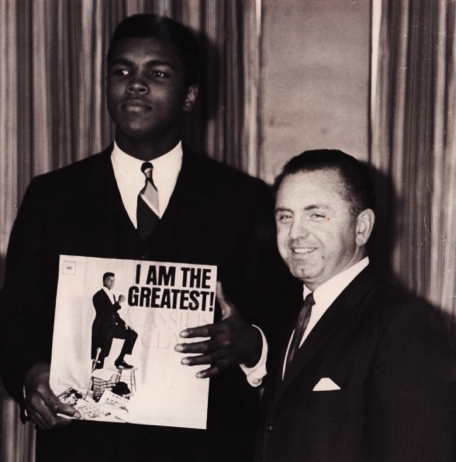
With Cassius Clay (later Muhammad Ali) in 1963.
He was born in Toronto on April 3, 1923, to Mary and Joseph Camilleri, immigrants from Malta, who named their third son Charles Emmanuel. His father and older brothers Michael and Vincent worked as labourers at a Dominion Tar and Chemical Co. (later Domtar) plant in Toronto.

After studying at Parkdale Collegiate, Camilleri enlisted in the wartime army, soon after moving to the Royal Canadian Navy. He served in the radar room aboard HMCS Gatineau, a destroyer that escorted convoys in the Atlantic. On one mission, a torpedo fired by a German U-boat narrowly missed the warship.

“One thing I can tell people is that it makes a man out of a boy in a hell of a hurry,” he told the Toronto Star six years ago.

While stationed at HMCS York in Toronto, Camilleri played for the navy football team coached by Teddy Morris, who had been an all-star running back and flying wing with the Toronto Argonauts.

After the war, Morris became head coach of the Argonauts and Camilleri earned a spot on the roster for the 1946 campaign. He stuck with the Big Four club for three seasons, winning the Grey Cup alongside the likes of star players Royal Copeland and Joe Krol.

The Ottawa Citizen judged Camilleri to be a “clever little quarterback” who was “a smart performer and a good team handler.”

The backup pivot, who carried the nicknames Red and Chick, also played as a back, catching a key pass from Krol in the 1946 Grey Cup game, a 28-6 victory over the Winnipeg Blue Bombers,

At only 145 pounds, Camilleri proved susceptible to injury in the hard-hitting Big Four, a precursor to the Canadian Football League. He suffered a separated shoulder in 1946 and a fractured pelvis in 1947.

In summer, Camilleri patrolled right-field for a fast-pitch softball team sponsored by People’s Credit Jewellers. The Toronto team claimed the Dominion championship in 1951 by sweeping the Vancouver Girodays 2-0, 2-1, and 17-1 in a three-game series played at Calgary.

After retiring from the gridiron and the softball diamond, he took a position with the federal government aiding fellow veterans. In 1958, he joined Columbia Records of Canada (later CBS Canada), eventually becoming national promotions director before being named national director of artist development in 1977. He retired in 1988 as a vice-president.

One of his odder responsibilities included promoting a long-playing record featuring a brash, young American boxer named Cassius Clay, soon to change his name to Muhammad Ali. The 1963 album featured the pugilist’s spoken-word recitations backed by music. The disk was called “I Am the Greatest!” Considering the performer, the title carried with it not a hint of irony.

Camilleri was an indefatigable promoter, earning a reputation as a stalwart defender of country music even as rock became the dominant genre. He successfully encouraged concert promoters seeking a rock audience to bill harder-edged acts with crossover potential such as Charlie Daniels and Larry Gatlin.

After the singer and keyboardist Burton Cummings left the Guess Who, Camilleri flew across Canada armed with boxes of a debut solo single to ensure Cummings got radio airplay. “Stand Tall” became a Top-10 hit in both Canada and the United States.

A sampling of the list of performers whom he met includes Heart, Donovan, Tom Jones, Tony Bennett, Roy Orbison, Carlos Santana, Lou Rawls, Andy Williams, Janis Joplin, Johnny Winter, Willie Nelson, Blue Oyster Cult, and Bob Dylan. Camilleri also attended the Canadian debut concert of Bruce Springsteen on Dec. 21, 1975, at a field house at Seneca College in Toronto. About 3,100 tickets were sold to the gymnasium show, though those who claim to have attended now number in the tens of thousands. (The performance got panned by the Globe’s critic, whose review declared “Bruce Springsteen is not god” before concluding with the suggestion the rocker was “really just a one-man Sha Na Na.”)

A suit-and-tie man, Camilleri was a mature presence on the pop music scene. One of the young radio station music directors who heard his pitches recalls him “looking more like a bank manager than a record rep.” The executive dressed in looser styles when attending concerts, including wearing a Hawaiian shirt while promoting Dennis Wilson of the Beach Boys.

With his music connections, he was sometimes mistaken for Charles Camilleri, a world-famous accordionist regarded as Malta’s national composer, who also lived for a time in Toronto. The men were not directly related.

Even in retirement, the executive remained an active supporter of such charities as the Variety Club of Canada and the Tony Stacey Centre for Veterans Care.

A prominent member of the Argos alumni group, he took special responsibility for assuring his old teammate Joe (King) Krol, a shy and modest man, received the accolades due him. On Krol’s death at age 89 in 2008, Camilleri pronounced him “the greatest Argo ever.”

The players from those great post-war Argos teams were so poorly paid they took as their reward the honour of knowing they were the best in the land.

“We played for a box of beer,” Camilleri once said, “and got our brains beat up.”

Camilleri died of congestive heart failure on Dec. 23. He leaves his wife, the former Margaret (Peggy) Larsen, whom he had met while she worked on the order desk at the record label; sons Ron, a former record-company executive who now performs an Elton John tribute, and Rick, a former president of Sony Music Entertainment (Canada); and, a grandson, Spencer. A celebration of his life is to be held at 2 p.m. on Jan. 28 at the Royal Canadian Legion at 150 8th Street in Mississauga, Ont.

Charlie Camilleri (No. 73) won two Grey Cups with the Toronto Argonauts after serving in the navy in the Second World War. 

Wednesday, December 7, 2011

Eviction won't shutter Ministry of Casual Living's artistic ambitions

The artist Aubrey Burke in front of the Ministry of Casual Living. The gallery, in which many Victoria artists made their public debut, is losing its storefront after a decade. Chad Hipolito photographs for the Globe and Mail.

By Tom Hawthorn
Special to The Globe and Mail
December 5, 2011

VICTORIA

The sign on a whitewashed, one-story stucco building on a sleepy street looks, at first glance, like a government insignia.

It has white letters on a brown background in the style used by the provincial government in the 1980s.

It reads, “Ministry of Casual Living.”

On closer examination, the logo depicts not the provincial crest, but an abstract glyph. Some see in it what looks like an angry person.

You could pass the buildings for days without noticing any activity. With its odd name and abandoned appearance, the storefront generates a vaguely Orwellian feel.

It is located at 1442 Haultain St. in Victoria, at a quiet intersection in a residential neighbourhood where a handful of mom-and-pop businesses cover the corner — a barber, two groceries, a coffee shop, a video store, and a used- furniture shop.

If you knock on the door, you might meet Aubrey Burke, a 24-year-old university student who is majoring in art and minoring in business. He is also a part-time janitor for the school board. He introduces himself as the minister of casual living.
Aubrey Burke

“It’s common to walk out the front door and have someone say, ‘Hey. What’s happening in there?’,” he said. “They want to know, ‘Who are you? What are you guys doing?’ ”

For almost a decade, this address has been an art gallery for emerging artists, as well as a residence for whichever impoverished artist handles curatorial duties. The post comes with no salary, yet the reward comes in offering art to the world. You also get to use the nifty title of minister.

The living quarters are meagre — tiny washroom, makeshift kitchenette. “No shower, no laundry and pretty much no heat,” he said. “It’s cold. A dark, dank cave in the wintertime. It’s like urban camping. I consider it boot camp for the up-and-coming artist.”

A street-front window and a modest display space has been offered to artists since March, 2002. In every year since, the gallery has exhibited 50 weekly art shows.

The ministry’s website notes the curators have no interest in credentials or curriculum vitae.

“Anyone can throw down,” Mr. Burke said. “Lots of people have had their first show here. I had my first art show here.”

Artists are encouraged to experiment. “We try to get people to push the limits,” he said. “Do experimental stuff. If they’re into painting, push it a little farther. Paint on the window, paint on the walls, paint on your face. Not your typical art stuff on the wall.”

Earlier this summer, the artist Pudy Tong had a display called “Brand New!” in which he created a letter banner like those used for birthdays, or anniversaries. This was made by exposing paper to sun through a stencil. Once hung in the window, the sun’s rays washed out the rest of the paper, erasing the message.

The only limits placed on artists were to keep in mind the gallery’s neighbourhood setting, along which children regularly pass.

Alas, the ministry is being evicted. The building’s owner is putting up for sale the ministry’s headquarters and the adjacent two-story building that houses a grocery. The asking price is expected to be a cool $950,000, beyond the means of artists who scrounge to cover $640 monthly rent.

To bid farewell to the space, 30 artists have contributed 30 pieces for the final 30 days. It was called the Burnout Extravaganza.

Though they are losing their Fernwood gallery, the second to close in the neighbourhood this month because of rising rents and development pressures, the ministry is continuing with art displays in downtown windows over the holidays.

The founders deliberately chose a confusing name whose intent it was to encourage a vision of life away from the rat race.

“It was made ambiguous so people would keep questioning, keep more of an open dialogue about what it could be,” Mr. Burke said.

The artist has placed a familiar-looking red-and-black sign on the front door. It reads: “Sorry, we’re CASUAL.”

CUP RUNNETH OVER: The Grey Cup, emblematic of Canadian football supremacy, arrived at the Legislature on Friday, a rare visit to Vancouver Island for the silverware. The storied trophy was escorted by Geroy Simon and two teammates with the B.C. Lions, who won the championship in convincing fashion a week ago.

Andrew Harris, who played junior football out of Nanaimo for the Vancouver Island Raiders and who earned most-valuable Canadian honours in the big game, was not with them.

The players and the Grey Cup disappeared behind closed doors for a private autograph and photograph session with members of the B.C. Liberal caucus.

Perhaps that was a reward for the government allocating $563 million of public funds to renovate the Lions’ home at BC Place Stadium.

The Lions are owned by David Braley, whose company has donated to the Conservatives and who gained an appointment to the Senate last years.

After the private session, the trophy emerged with a grinning premier in tow to be presented to the little people — guards, passing schoolchildren, giddy members of the press gallery.

CHAMPS: Two Grey Cup champions once sat in the Legislature, though not at the same time. Herb Capozzi, who died last month, had two terms as a Social Credit MLA. Emery Barnes, a New Democrat, defeated Mr. Capozzi in the dual-member riding of Vancouver Centre in 1972. Mr. Barnes won re-election five times, serving for two years as Speaker of the House.

Mr. Capozzi was general manager of the 1964 Grey Cup-winning B.C. Lions, for whom Mr. Barnes played defensive end. He missed the championship game with an injury.


This article originally used an incorrect personal pronoun for the artist Pudy Tong.

Tuesday, December 6, 2011

Former Miss B.C. Lions went on to be hailed as a hero

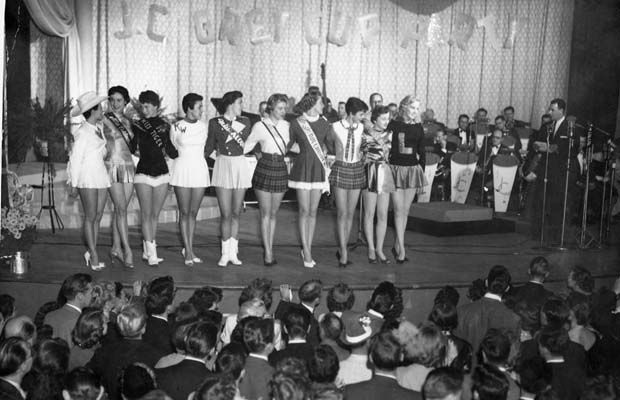
The contestants for the 1955 Miss Grey Cup pageant line up on stage in Vancouver. Glenda Sjoberg, the 18-year-old Miss B.C. Lions, is on the far right wearing a sweater with the letter L on the front. The crown went to Miss Edmonton Eskimos. 

By Tom Hawthorn
Special to The Globe and Mail
November 24, 2011

The Grey Cup parade featured clowns and cowboys; marching bands and baton-twirling majorettes; Mounties in Red Serge, a smart Stetson on each head, and Shriners in silky harem pants, a silly fez on each head.

In 1955, on the cusp of the first Grey Cup football championship to be played on the West Coast, tens of thousands lined the neon-lit streets of downtown Vancouver for a glimpse of the spectacle.

A procession of horses and tractors and colourful floats paraded past. There was a grizzled prosector with a mule and an inexplicable Saskatchewan display featuring a man in a football costume shoveling wheat over his shoulder onto the blacktop.

An open convertible carried Marilyn Bell, who was cheered by the throngs a year after the teenaged swimmer conquered Lake Ontario.

Towards the end, a young woman wearing a sweater in the black-and-orange livery of the local football team waved to the crowd while sitting atop the trunk of a convertible.

This was Miss B.C. Lions, a beauty queen selected to represent the team in the contest to be named Miss Grey Cup.
Miss Grey Cup escorts the trophy at 1955 parade.
Glenda Sjoberg, known as Goldie for her lustrous locks, was an 18-year-old logger’s daughter from Nanaimo. According to the newspapers, she was “Glamorous Glenda,” a “comely,” “charming,” “beautiful,” “tall, blue-eyed blonde.” She had won a local beauty pageant to become Miss Nanaimo before defeating 22 other contestants to become Miss PNE (Pacific National Exhibition).

She won a gold compact, a white Arctic fox fur shoulder piece, and a carved hardwood salad bowl from the British West Indies. Officials presented her a cheque for $1,000, which she said would be used to pay for treatments for her mother, Olga, bedridden with arthritis.

As Miss PNE, Miss Sjoberg automatically became Miss B.C. Lions, making necessary a crash course in football, a sport about which she knew little.

In the end, she did not win the Miss Grey Cup title, which went to Miss Edmonton Eskimos. The Eskimos were also successful on the gridiron, defeating the Montreal Alouettes, 34-19, to claim the trophy. Empire Stadium was packed with 39,417 paying customers, a Grey Cup attendance record that would stand for 21 seasons.

For a young woman from Vancouver Island, her reign as a local pageant queen was a whirlwind of adventure. (But not too much adventure. She was chaperoned by a family friend.) She did not entertain visions of trying to break into movies.

“Hollywood? No thanks,” she said at the time. “That kind of life just isn’t for me.”

After the game, she returned to the anonymity of life as a dental assistant on Vancouver Island.

A few years later, she graduated from a course for stewardesses conducted by Trans-Canada Air Lines. They issued a press photograph to promote their hiring of a former Miss B.C. Lions.

Miss Sjoberg had been on the job less than a year when she would need to call on all her training.

On Oct. 3, 1959, she was aboard a Viscount airliner on approach to Malton airport, outside Toronto, in a blinding rainstorm. The stewardess was handing out hats and jackets to the passengers when intuition led her to quickly take her place in a rear-facing jump seat. Just as she was about to buckle the seatbelt, the plane touched down hard before becoming airborne again.

Short of the runway, speeding along at 120 m.p.h., the plane clipped a light pole, ripped off barbed wire atop a fence surrounding a covered reservoir, bounced into the air, narrowly missing a transformer, before skidding over a ditch and across a road and over another ditch, then tearing down a section of the fence surrounding the airport before coming to a thudding halt, the fuselage cracked in half.

“Wham, bam, crash,” the retired stewardess remembered on Tuesday. “The lights went. There was dust and dirt.”

For a moment, there was also silence.

A woman cried out. She had been holding twin baby girls in her arms and both had slipped from her grasp on a hard bounce. The infants were found beneath the seats, unharmed.

Miss Sjoberg ensured the passengers and crew were evacuated before going for help.

“I’ve got no shoes on and it’s raining,” she said. “What am I going to do? I’m not going to go looking through metal and mud for them.”

She made her way in stocking feet to a nearby service station, telling them to call for an ambulance. Then she returned to the plane to assist three fellow crew members and 36 passengers. Among them was Ward Cornell, the sports announcer who was about to make his debut on Hockey Night in Canada.

Four went to hospital with injuries, including the pilot and the other stewardess. All survived.

“Everybody” she said, “was very lucky.”

Some contemporary accounts hailed her as a hero.

The crash was blamed on wind sheer. The turboprop was a write-off.

The following year she married Pete Kinzie, a pilot. She had to quit her job, as married women were not allowed to work as stewardesses in those days.

She enjoyed the work, and now remembers happily the pleasures of passenger flight in those days. She has yet to see an episode of the period drama Pan Am.

She traveled the world with her husband before settling in Burlington, Ont., where today a 75-year-old retiree can barely believe she was once Miss B.C. Lions.

“I was not a beauty-pageant type,” she said. “I did it for my mother.”

This Trans-Canada Air Lines Viscount landed short of the runway at Toronto's Malton airport in 1959. It skidded along the ground along the length of several football fields. All 40 passengers and crew survived, including a stewardess who had been a beauty queen.

Wednesday, February 2, 2011

The darkened neon light of a family cafe

Tyke Thodos ordered a new sign for the family cafe soon after taking charge in 1950. He got a beauty. BELOW: Day-time cook Mr. Wong, photographed in 1973 by Nina Raginsky.

By Tom Hawthorn
Special to The Globe and Mail
February 2, 2011

VICTORIA

The bread came stacked on a tiny plate, slices cut thick. On a good day, the supply was replenished as soon as you dipped the last piece into a bowl of chowder.

Constantine Thodos, known as Tyke, thought his customers deserved tasty bread, strong coffee, and fresh fish. He supplied all at a reasonable price.

Mr. Thodos took over the family cafe in Vancouver at age 24 in 1950. He was involved in its operation for decades. On his death two weeks ago, aged 84, the city lost a restaurateur deserving of accolades for nurturing an oasis of good eats in a neighbourhood suffering from a long decline.

His father had been slinging hash in Vancouver since before he was born.

Nick Thodos, who chased gold in the Yukon, became cook and part-owner of the English Kitchen in 1912, likely walking the four blocks to work each morning from his room at the Patricia Hotel.

He was eventually joined by his brother, Gustave, who worked as a waiter. The two opened a restaurant of their own five doors west in a former jewelry store at 20 East Hastings St.

In those days, the Hastings strip was the heart of the city’s business district, crowded with theatres and new brick office buildings.

Their joint boasted a roof of pressed tin and 18 stools around a counter. Patrons crowded the tiny cafe, eager to sample seafoods fried and boiled and steamed with Mediterranean flair by the chef. The brothers named it The Only cafe.

By the time Tyke took over, the city’s commercial centre had moved, but the old neighbourhood remained busy with loggers, fishermen and shoppers visiting the nearby Woodward’s department store. The city’s newspaper offices were just a short stagger away. Theatre patrons in their finest dropped in for a snack after the show.

Tyke squeezed two booths into the tiny space. He ordered clams from Thetis Island and got the day’s catch from the docks at the foot of Campbell Avenue. The cafe had a four-page cardboard menu, but all you needed to know you could see in the front display windows, where fish rested on beds of ice.

The son had been running the place for less than a year when he made a propitious decision by commissioning a sign from Neon Products.

He got a beauty of neon tubing and sheet metal painted yellow-gold and navy blue. At night, ONLY SEA FOODS was illuminated in an eerie green, while a sea horse, the tail oddly curled in the wrong direction, was lit in orange outline with fiery red eyes.

For decades, the sign was a beacon for those seeking an honest meal at a fair price.

Tyke operated The Only with help from his brothers. One of them, a chunky athlete named Pete, played professional football. In 1948, Pete traveled to Varsity Stadium in Toronto for the Grey Cup game. With his Calgary Stampeders trailing the Ottawa Rough Riders, by 7-6, the son and brother of restaurateurs was handed the ball.

What happened next was described by Jim Coleman in the Globe: “The stunned Ottawa linemen shifted to the right to stop two Calgary decoys, and Pete Thodos scored easily as he galloped through strangely uninhabited territory.”

Pete Thodos scored the winning touchdown in Calgary’s first Grey Cup championship. He later played a single game for the B.C. Lions in their inaugural season.

The cafe fed generations of artists, writers and musicians, some of whom became convinced that the cafe’s sweaty, ruddy-faced short-order cook was the model for the cartoon character Reid Fleming, the World’s Toughest Milkman. David Boswell, the illustrator, created the character before coming to the city, but acknowledges a strong resemblance.

The artist Keith McKellar, who has written a splendid ode to The Only in his book “Neon Eulogy,” recalls drunks passing out at the counter, only to be awakened by the cook administering a pinch to the back of the neck.

The family handed over day-to-day management of the cafe in the early 1990s, as the neighbourhood declined in the post-Expo 86 era. Police discovered open drug dealing inside the cafe and it was closed for health violations 20 months ago. It has been reported the rights to the cafe’s name have been leased to the Portland Housing Society, which has expressed interest in operating a cafe as a social enterprise. Last summer, the spectacular neon sign was removed for repairs and safekeeping.

On Friday afternoon, friends and family are to gather at the Hellenic Community Centre to celebrate the life of a man who kept the city fed with pepper chowder and halibut cheeks.

Many of the artists and musicians who enjoyed The Only's good eats at fair prices thought the cook a dead ringer for the cartoon character, "Reid Fleming, World's Toughest Milkman." David Boswell conjured the character in his imagination before moving to Vancouver, but went to 20 E. Hastings St. to check out Reid's doppelganger. He snapped this photo in 1983.