Showing posts with label blethering place. Show all posts

Tuesday, December 27, 2011

Hundreds of $10 heroes keep the Tall Tales coming

By Tom Hawthorn
Special to The Globe and Mail
December 26, 2011

VICTORIA

A look back at the year that was:

In June, the Big Bad Wolf knocked at the door of Tall Tale Books, a children’s store.

The owners, Kate and Drew Lorimer, were prepared to shutter the store, giving up on a dream of creating a bright, kid-friendly bookstore of their own in downtown Victoria.

They decided to take one last shot, hitting on the idea of what they called the Hero Society. They asked patrons to subscribe for as little as $10 per month in exchange for merchandise at the store. That way the couple could have a predictable, guaranteed income and keep the store afloat.

Kate, Drew and Emma Grace Lorimer.
In a month-long campaign, they sought 400 subscribers by Canada Day.

How’d they do?

”Six months later, we’re still here,” Mr. Lorimer said.

“We got a little over 300, so we didn’t quite make out goal, but we’ve got an amazing group of people supporting us. Things are definitely better. It’s still week to week, month to month. We’re never out of the woods.”

The store’s third Christmas season has been its busiest yet. Particularly popular have been Patrick McDonnell’s Me ... Jane (“a picture book about Jane Goodall as a kid — adorable, simple sweet story but inspirational”) and Sherri Duskey Rinker’s Goodnight, Goodnight, Construction Site (“a humourous bedtime lullaby book about construction vehicles on a worksite going to bed with teddy bears and blankies”).

In the end, another year passed with the Lorimers having kept the wolf at bay. Can’t yet call it a happy ending, as the story of Tall Tale Books is still being written.

Of the more than 50 “Eyes on the Island” columns published this year, none got as much attention as a report on Daniel Loxton’s efforts to get published an illustrated children’s book on evolution. The Victoria writer and illustrator shopped his book to American publishers, none of which would agree to bring the book to market.

Instead, the evolution book was released by Canadian-owned Kids Can Press of Toronto.

The news that American publishers wouldn’t touch a children’s book about evolution generated about 600 Tweets, including one by the film and culture critic Roger Ebert, as well as more than 4,000 Facebook recommendations. It was mentioned on CNN.

Mr. Loxton’s book, Evolution: How We and All Living Things Came to Be, went on to win the prestigious Lane Anderson Award for young readers. The judges described the book as a “tour de force of science writing.”

Soon after, Loxton launched his second book, Ankylosaur Attack, at Tall Tale Books. A herd of dinosaur-loving children, many of them exhibiting their fierce claws and fangs, listened to the author Grr! Arr! and Rawr! his way through a reading.

Social media also played a prominent role in the municipal campaign of Lisa Helps, who was one of three rookies elected to Victoria city council in November. Ms. Helps’ savvy operation included regular Facebook and Twitter updates. She called on other candidates to join her in a hootenanny at Logan’s Pub and she held weekly work crews to repair fences and tidy community gardens.

The candidate whose name doubles as a campaign slogan finished in third place in the at-large election, within striking distance of topping the polls.

After her victory, she converted her campaign website into one in which she asks the public for input on issues facing council. Her slogan: “A city where citizens lead.” It will be interesting in the new year to see if the citizens feel any more empowered with this council than its predecessors.

Last January, we looked at the shuttering of the Blethering Place, a restaurant on Oak Bay’s High Street decorated as though by one’s eccentric English auntie. For three decades, the restaurant served as Victoria’s “favourite faux Tudor tearoom,” as it was called, offering bangers and mash to a clientele that included Graham Kerr, the Galloping Gourmet. Today, the Oak Bay Bistro offers bison, chicken liver parfait, and local artisan goat cheese from Saltspring Island.

Fish and chips? Not on the menu. But there is slow-roasted Arctic char with roasted sunchoke and sweet potato hash.

Oak Bay has lost some of its Olde England flavour. All for the better.

Monday, January 31, 2011

Blethering Place serves its last cup o' tea

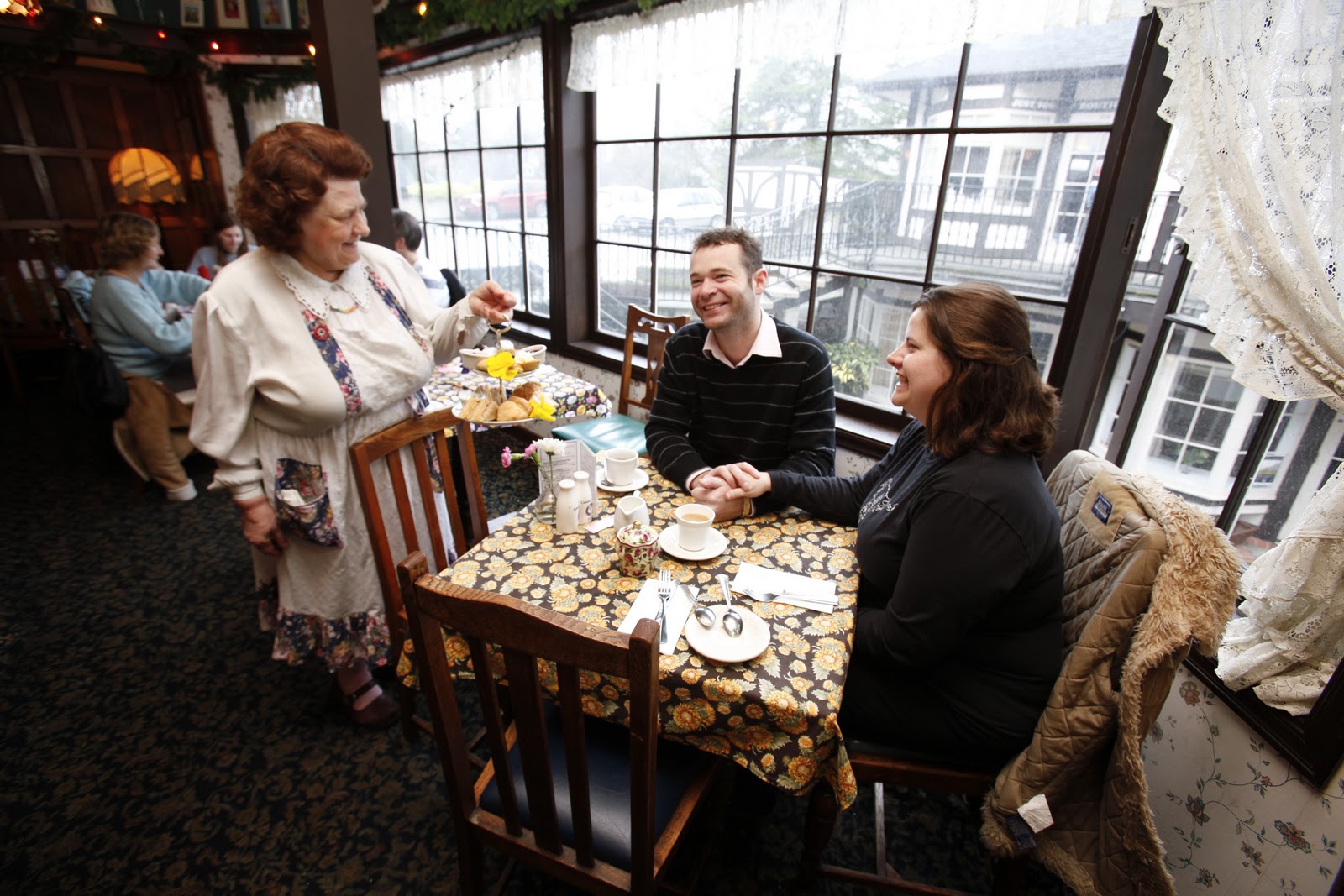
Eating at the Blethering Place was like visiting your dotty aunt for lunch. Photographs by Deddeda Stemler.

By Tom Hawthorn
Special to The Globe and Mail
January 31, 2011

VICTORIA

The Union Jack has been lowered over the Blethering Place Tea Room for the final time.

The banner flew over a landmark restaurant in Oak Bay, a municipality whose borders are teasingly described as the Tweed Curtain.

The Blethering Place, where tour buses stopped and the Galloping Gourmet recorded two episodes of his television cooking program, served its last scone and poured its last cuppa on Sunday.

After three decades of helping convince American tourists that Victoria is an outpost of Merry Olde England, the owner is closing the doors. The city’s “favourite faux Tudor tearoom,” as it has been called, is to be replaced by new owners who have in mind a modern bistro.

“It was an oasis,” said Ken Agate, the 66-year-old proprietor who lives in an apartment above the restaurant overlooking Oak Bay Avenue, the local High Street. “It’s not about being fine dining. It’s about being comfortable and welcome.

“It wouldn’t matter if you sat here all day. You can bring the baby. You don’t need a reservation. You don’t even have to eat.”

The restaurant has been packed this week, as old-time customers returned to sample such dishes as Welsh rarebit, shepherd’s pie, bangers and mash, and a breakfast item billed as “eggs Benedict Arnold.”

While online reviews of the cuisine can kindly be described as mixed, the room earned accolades over the years from travel writers for the Seattle Times (“beloved and venerable”) and the Los Angeles Times (“lots of local ‘old ducks’ chattering away”).

Diners sat in a room filled with such bric-a-brac as dolls and lesson books, toffee tins and biscuit boxes, packaging for blancmange and mushy peas. A portrait of Winston Churchill shared a wall with two Union Jacks.

The decor consisted of “oak panelling, lace curtains, seersucker tablecloths,” the New York Times once noted, while the clientele “look as if they have emerged from the background of an Agatha Christie mystery novel.”

Tea was served in pots covered by crocheted cozies. It was like eating at your dotty aunt’s place.

Mr. Agate bought the restaurant on a whim. He saw the tea room, thought, “I could do that,” and walked in to buy the business. The owner declined, but that very night Mr. Agate got a call from the owner’s wife. Over time, Mr. Agate expanded the space to take over an adjacent grocery and realtor’s office.

He had not been a restaurateur before taking over the tea room, though his family had dairy expertise. Mr. Agate was born in the Fijian coastal village of Navua, where his father introduced ice cream to the tropical archipelago. He grew up in Palmerston North on New Zealand’s North Island, where an early job at a department store led to work as a traveling salesman. He married a hairdresser and eventually owned three salons, which were sold to finance a relocation to Vancouver Island.

He took over the restaurant on the first day of 1981, when, as he puts it, “I got into the beautiful rut of the Blethering Place.”

The tea room took its name from a Scottish word for “voluble senseless talking.”

One day, he spotted among the diners Graham Kerr, the popular cook known by his television audience as the Galloping Gourmet. Mr. Kerr had begun his media career in New Zealand, so the two hit it off, and soon after two episodes for the chef’s syndicated program were taped in the tea room.

The tea room shared a block with such businesses as the Penny Farthing pub and the Tudor Sweet Shoppe, which contribute to the neighbourhood’s sense of British heritage. Yet, Oak Bay’s exclusive Uplands neighbourhood was designed by American landscape architect John Charles Olmsted, while other subdivisions were planned according to principles outlined by American sociologist Clarence Perry.

The Union Jack that once flew over the restaurant, shredded by winter winds, has found a home in Washington state. A vexillologist in the city of Battle Ground, north of Vancouver in Clark County, collects distressed banners. The Union Jack is tattered by weather, not war, an appropriate keepsake for Battle Ground, which takes its name for a site on which an anticipated battle did not take place.

The Blethering Place, where tour buses stopped and where Graham Kerr taped two episodes of The Galloping Gourmet, was a landmark on Oak Bay Avenue.

Monday, November 22, 2010

Tweed Curtain sets apart a riding with an independent streak

An old car and a cup of tea capture life on Oak Bay Avenue.

By Tom Hawthorn
Special to The Globe and Mail
November 20, 2010

VICTORIA

The Tweed Curtain runs along Foul Bay Road, a dividing line of myth and imagination separating ordinary Victoria from the enclave of Oak Bay.

Behind the Tweed Curtain can be found a last bastion of the British empire, where high tea is enjoyed on a High Street. In the three-block long stretch of shops known as the Oak Bay Village, a Union Jack flutters above the Blethering Place Tea Room. The restaurant is a few steps from the Penny Farthing pub and the Tudor Sweet Shoppe, the spelling a bit twee even for a purveyor of fine comestibles of the chocolate variety.

The shopping district offers antiques and art galleries, bakeries and bookstores, a toy store and a crafts shop.

Every summer, along this stretch, a parade of antique vehicles and marching bands trundles past in the annual Oak Bay Tea Party Parade. The parade is led by a man dressed as the Mad Hatter. This Tea Party celebrates a favoured beverage, not a political tendency.

The local MLA, Ida Chong, has paraded in an open convertible, helpers distributing candies to the delighted children who line the route.

For 14 years, she has represented a waterfront constituency at the extreme southeastern tip of Vancouver Island. The double-barreled name of Oak Bay-Gordon Head evokes comfort and perhaps even privilege. The 38,415 voters share the riding with two private golf clubs, the city’s most prestigious private schools, and the Royal Victoria Yacht Club. It is also home to two hospitals and the leafy campuses of Camosun College and the University of Victoria.

It has been called “veddy, veddy British,” “a suburban oasis” and a “conservative, upper-crust area.”

What does geography professor Larry McCann, born 65 years ago in Oak Bay and now a resident of the riding’s Cordova Bay neighborhood, think of the Tweed Curtain designation?

“Inappropriate,” he said. “Long gone. Just doesn’t apply because of relatively strong immigration. The ethnic mix has changed.”

At first glance, the riding does not seem promising ground in which to plant a political insurgency.

As is familiar to letter carriers and newspaper deliverers, simply canvassing some of the wealthy neighbourhoods — such as Ten Mile Point, or the the Uplands, designed by the son of the man responsible for plotting New York’s Central Park — can be daunting, as mansions sit on lots as large as 0.8 hectares.

Yet, the corporation of the district of Oak Bay also offers modest bungalows in a section just across the Tweed Curtain known as The Poets, where the streets are named Byron, Milton and Chaucer.

The riding’s Gordon Head section, which is part of the district of Saanich, is the more populous part of the riding. It is more suburban in design and also more ethnic, including a notable population of Chinese-Canadians and Indo-Canadians.

A snapshot of the riding provided by BC Stats shows an older, better educated, and wealthier population than the provincial average. One voter in five is a senior, while the average household income in 2005 of $90,526 was substantially more than the provincial average of $67,675.

Many of the residents have a professional background, as the riding is home to civil servants from all three levels of government, as well as clerks and educators.

Mr. McCann notes an influx of young families has made the riding more diverse, while a transient student population offers a group of voters perhaps more concerned with issues of social justice.

Elizabeth Cull, a small-business owner who represented the riding for the NDP for seven years before losing to Ms. Chong in 1996, describes the voters as active and informed, especially about public policy issues.

“I found you could spend an awful lot of time on the doorsteps talking to people about what was happening in the province,” Ms. Cull said.

“This is a well-educated electorate and they like to talk about the issues.”

The riding has a history of independence, often bucking the governing party. Dr. Scott Wallace won the seat for the Conservatives in 1969, held it against an NDP landslide and retained the seat after a revamped Social Credit party swept to power in 1975.

“They are independent minded,” Ms. Cull said. “They voted for Scott Wallace for years, because Scott was a person of integrity who represented them well.”

Ms. Cull lives in South Oak Bay, where “people know their neighbours. It’s friendly. It’s livable. There’s a sense of safety and security.”

The former B.C. finance minister is now proprietor of the local Dig This chain of gardening stores. One outlet can be found at the intersection of Oak Bay Avenue and Foul Bay Road, the very entrance to the Tweed Curtain.