Showing posts with label victoria. Show all posts

Tuesday, February 28, 2012

At 88, Victoria's Blue Bridge begins to come down

Workers complete the wood decking of a bridge in Victoria in 1924. For 88 years, the Johnson Street Bridge, popularly known as the Blue Bridge for the colour of the paint used to match the oxidation of the structure, has spanned a narrowing of the Inner Harbour in Victoria. The bridge was designed by the same man responsible for the Golden Gate Bridge in San Francisco.

By Tom Hawthorn
Special to The Globe and Mail
February 27, 2011

VICTORIA

The barge Arctic Tuk was anchored in the still waters of the Inner Harbour with one end tucked beneath a bridge whose days are numbered.

The barge held a Manitowoc 4600 Series III, which is the formal designation for what is a super-duper, heavy-duty crane from what looks like the world’s biggest Meccano set.

On the bridge deck, men in hard hats wearing reflective vests and special breathing apparatus, their eyesight protected by shields, completed the severing of a venerable bridge from its terrestrial mooring.

The Johnson Street Bridge, better known as the Blue Bridge, a longtime city landmark, designed by the same man responsible for the Golden Gate Bridge, is to be replaced.

First, though, a structure that has safely transported generations across the water needs to be removed. On Friday, crowds gathered in a downpour to witness the first stage of demolition, the removal of a parallel railroad train deck.

For some, it was a happy day in which to herald the future of the city. For others, it was a time to bid adieu to an old friend, a sad moment in which an historic landmark was discarded like a pair of worn-out shoes.

Ross Crockford, who organized a spirited but ultimately failed campaign to preserve the bridge, looked crestfallen.

“Not a happy day,” he said. “Not a day to celebrate.”

Mr. Crockford and others urged the old bridge be refurbished instead of replaced. They gained enough signatures on a petition to force the city to hold a referendum, only to end up losing at the ballot box.

“As soon as I heard the referendum results, I knew this day would come,” Mr. Crockford said.

The 88-year-old bridge was painted blue some years ago, a colour choice made to match the oxides of the corroding structure.

The Blue Bridge has inspired the naming of a local repertory theatre, a batch of India pale ale, an anthology of memoirs (“Beyond the Blue Bridge”), as well as a song by The Bills titled, “Old Blue Bridge.” It is a bluegrass number, of course. “The old bridge is coming down,” the Bills sing in the tune’s opening line, recorded seven years ago.

The bridge enjoyed cameos in several Hollywood films, as well as a more prominent role in the 1997 action comedy Excess Baggage, starring Alicia Silverstone, Benicio Del Toro and Christopher Walken.

The steel bridge depended on counterweights to lift either deck for passing vessels. The bascule (from the French for “seesaw”) design had been patented by Joseph Baermann Strauss, a Cincinnati-born engineer whose university thesis described the construction of a railroad bridge across the Bering Strait.

When lifted, the road and rail bridge spans seemed to imitate the beak of a traditional Kwakiutl mask.

(For the past several months, the rail portion has been left in the lifted position. Some thought it looked as though the city of Victoria was giving a blue finger to the residents of Esquimalt.)

The removal of the bridge deck on the weekend also severed a rail link to downtown Victoria that had existed since 1888, when the Esquimalt and Nanaimo Railway was constructed as part of the fulfillment of a promise when the colony of British Columbia joined Confederation in 1871.

The replacement bridge, which is to be built slightly to the north and expected to be completed by 2016, does not include a rail component.

The old railway deck is to be barged to the Ralmax yard further along the harbour. Some of it is to be retained for sculptural pieces, while most of it will be dismantled and barged to the Lower Mainland, where it will be melted down.

A local radio station joked the Blue Bridge ought to be recycled in blue boxes.

As the rain fell, 26 students from James Bay community school arrived for a real-life lesson. They walked two wet kilometres from their schoolhouse to see a simple machine in action.

The Grace 5 class was led by vice-principal Scott Clazie, who leaned in to explain the science of levers and cranes.

“Public safety announcement,” Mr. Clazie bellowed in his loudest voice. “Do not put your fingers under the bridge.”

The teacher grinned broadly. One of his pupils rolled her eyes.

As an entertainment, the dismantling of a bridge is more exciting in imagination than it is in practice.

Watching part of the famous Blue Bridge being removed turned out to be as exciting as watching blue paint dry.


CBC Radio's On the Island aired a terrific documentary on the Blue Bridge and its lore. You can hear it here.

Friday, January 6, 2012

Book celebrates Victoria's notable private residences

The author Nick Russell stands in front of Pinehurst, an 1889 mansion in Victoria's James Bay neighbourhood. Chad Hipolito photographs for the Globe and Mail.

By Tom Hawthorn
Special to The Globe and Mail
January 4, 2012

VICTORIA

The block on which Thomas Donovan built his family home included three carpenters, two laborers, a butcher, a saddler, a plasterer, and a letter carrier.

It also boasted a bricklayer. You only had to look at the exterior of No. 23 Milne St. to know where he lived.

In a city surrounded by forest, with mills lining the waterways and timber both plentiful and cheap, Mr. Donovan built his home of red brick.

It has a hipped roof and cross gables, as well as a patterned frieze separating the ground floor from the second. The home is a spectacular testimony of a craftsman’s skill.

The records suggest it took him three years and $2,000 to complete by the time his family moved in 110 years ago.

The Donovan house is one of the homes featured in Glorious Victorians, an illustrated book celebrating the capital city’s stunning stock of notable private residences. The book’s subtitle promises 150 houses to mark the city’s 150th birthday this year, with entries from castles to cottages, and in architectural styles ranging from Queen Anne Revivals with their fussy gingerbread woodwork to art-deco wonders of sleek, curvilinear shape.

As the capital of a province dependent on natural-resource industries, with dramatic boom-and-bust cycles, it is a wonder so many remarkable homes have avoided the wrecking ball.

Victoria has lucked out. After the gold rush, the booms were never too loud, nor the busts too desperate. Where vast swaths of Vancouver have been leveled, grand private homes replaced by apartment towers in the West End and modest cottages torn down for Vancouver Specials, the capital’s steady growth left intact an inventory of homes spanning a century-and-a-half of favoured styles.

A charming streetscape is one of Victoria’s understated lures.

“The city has attracted people who like what they find and want to keep it that way,” said Nick Russell, the journalist and heritage researcher who produced the book. “A lot of people move here and stay because they love the ambience.”

His research has found worthy homes in all corners of the city, including a cottage along the harbour waterfront that is all but invisible from the street, hidden as it is behind a curtain of trees. It can be spotted from the water if one looks down from the deck of the passing MV Coho ferry.

His favourite street for house sightseeing will come as little surprise to anyone familiar with the city.

“I still get a frisson of pleasure driving up Rockland where there are so many glorious, classic buildings from 1910, 1912, and where you also come across ultra-modern buildings, which are exciting architecture in their own right. I like that mix.”

Mr. Russell, 73, has renovated two houses since moving to Victoria from Regina more than a decade ago. The first was a homestead-style house covered in stucco and in disrepair as a longtime rental. During the renovation, it was learned the house dated not from 1900, as thought, but from 1861, when it was built for one of the first African-American families lured to the colony by Gov. James Douglas.

The second is his current home in the James Bay neighbourhood. It is known as the Mansard House for its roofline, an uncommon style in Victoria. He did not include it in his self-published book, as the house once had been lifted to make room for a full basement, losing the original integrity of the design. He and his wife, Sharon, worked on the restoration, which received an award from the local Hallmark Heritage Society.

The longtime reporter and educator trained many of the reporters whose bylines can be read in British Columbia newspapers. As well, he wrote Morals and the Media, a book on ethics in journalism. (Insert your own wisecrack here.) He was senior editor of This Old House, a four-volume register of Victoria’s historic homes produced by the Victoria Heritage Foundation.

Working with other researchers, Mr. Russell picked through the detritus of city hall’s attic and found dusty ledgers with valuable information for those interested in researching house histories.

So far, he has gathered 3,600 plumbing permits, 6,450 water permits, and 8,218 building permits, a dreary accumulation of data for the uninitiated but a trove of detail for researchers. The goal is to have this information made available online.

An advocate of preservation, Mr. Russell does not want Victoria to become a time capsule. A city is living space for people, he notes, not a museum.

Nick Russell checks out the architectural drawings for one of Victoria's spectacular homes.

Tuesday, December 20, 2011

'Ambassador of art' makes painting a spectator sport

Judy McLaren has been artist in residence at the Fairmont Empress in Victoria since August. A glimpse in the kitchen led to this oil painting, titled "Pastry Chefs."

By Tom Hawthorn
Special to The Globe and Mail
December 19, 2011

VICTORIA

Judy McLaren stepped back from the canvas, then tilted her head before reaching forward to make broad strokes with a brush.

She wore paint-splattered gloves on both hands. A drop sheet protected the carpet.

Painting can be a reclusive activity, typically practiced alone in a studio or garret.

Not so for Ms. McLaren, who is creating art as a form of spectator sport.

A stream of passersby flowed past. From time to time, people stopped to watch, commenting on the work.

The artist has been on public display in the upper lobby of the Fairmont Empress Hotel since summertime. She is the current artist in residence at the stately hotel. For several days of the week, she can be found daubing and dabbing outside a temporary gallery housing her latest works.

Her role is to be “an ambassador of art,” she told one recent visitor.

If so, her attaché is Bubbles, an amiable seven-year-old goldendoodle with black fur who is her constant companion. Bubs, as she is also known, caused a minor diplomatic flap the other day when she helped herself to a chocolate treat attached to a gingerbread house on display in the lobby.

The artist and her dog have been daily features of hotel life for six months now. Ms. McLaren wanders the halls in search of subjects, as she has made the hotel the focus of a series of 16 paintings completed so far during her residency.

She has portrayed the hotel’s elegant tea room, which is a popular stop for tourists, as well as the Bengal Lounge, where an ancient tiger skin over the fireplace is a reminder of an empire’s former reach.

A thin woman of bright temperament and an ease at making acquaintance of strangers, Ms. McLaren, 60, has taken on a heavy workload with ambitious goals. She knows it is a rare privilege for an outsider to explore the nooks and crannies behind the curtains of a busy hotel.

“An artist doesn’t get chances like this all the time,” she said.

Her current canvas includes the early outlines of a painting featuring the banquet staff having a meeting in an empty dining room. She was attracted by the light of the room, where an afternoon sun turned long-stemmed wine glasses into vertical streaks of silvery white.

Kamal Silva by Judy McLaren
The artist has completed portraits of general manager Martin Leclerc and executive chef Kamal Silva. More remarkable is to see the working staff of the hotel portrayed in oils. Perhaps the most dynamic of her hotel works depicts a quartet of pastry chefs in an intense discussion. The artist has an affinity for the kitchen, where the industrial setting is offset by cooks in brilliant white coats and chefs topped by mushroom-shaped toques blanches.

“Whites,” she pronounced, “are so wonderful.”

The artist was born in 1951 in Guernsey, the British crown dependency whose bailiwick includes several islands in the English Channel. Her birth came just six years after the Germans were expelled from the only British soil occupied during the Second World War. Her father was an Anglican priest whose parish included the isolated and bucolic isle of Sark.

After postings in England, the family decided to immigrate to Ontario, her father taking a teaching position at Upper Canada College in Toronto.

Ms. McLaren graduated from the Ontario College of Art and Design. She has been an illustrator for children’s books and does many commissioned oil portraits.

Her husband is Keith McLaren, a senior master with BC Ferries who can be found aboard the Spirit of Vancouver Island as it plies the waters separating Swartz Bay and Tsawwassen. He won a prestigious award for a book on the schooner Bluenose, one of three books he has written.

The artist has tailed porters, sous chefs and housekeepers. On Friday, she spotted Amanda Demontigny, a 16-year employee, at work cleaning the upper lobby. The worker scrubbed a staircase, her silhouette outlined by a grand window through which could be seen a spectacular, shimmering background orange leaves.

“She’s going to be starring in one of my paintings,” the artist vowed.

“That’s if you can catch me,” the cleaner replied, mopping feverishly, step by step.

Passersby admire the work of painter Judy McLaren, who paints daily in the upper lobby of the Fairmont Empress Hotel in Victoria. Chad Hipolito photograph for the Globe and Mail.

Tuesday, December 6, 2011

Election winners: A poet, a prosecutor and a partier in a Prius

Dean Fortin won easy re-election as mayor of Victoria, though two incumbent councillors he endorsed endured a surprising defeat. Chad Hipolito photograph for the Globe and Mail.

By Tom Hawthorn
Special to The Globe and Mail
November 21, 2011

VICTORIA

Scenes from an election:

The news left John Luton crestfallen. He had lost his seat on Victoria city council. At 57, he wondered aloud about his future employment.

“I’m not afraid of hard work,” he said, before noting, “It’s a time of life when it can be very hard to find a job.”

All around him, people were celebrating the re-election of Victoria mayor Dean Fortin and two members of what was billed as Dean’s Team — councillors Pam Madoff and Marianne Alto. Mr. Luton and Lynn Hunter, a former member of Parliament, were two members of the team who lost their re-election bids.

Mr. Luton lingered at Mr. Fortin’s victory celebration at the Union Pacific Coffee Co. to thank volunteers.

He was in the midst of contemplating his future when interrupted by Ben Isitt, 33, an academic and author who had just won election to council.

Mr. Isitt grabbed his right hand.

“You were the part of the Dean Team that I most wanted to work with,” Mr. Isitt said.

As they continued their exchange, the ebullient Mr. Isitt pumped Mr. Luton’s hand again and again.

Mr. Luton offered a wan smile. He then put on his helmet and reflective vest to cycle home alone in the dark.

* * *

Victoria is still small enough that some campaigns operate from the kitchen table.

After the polls closed, Victoria councillor Charlayne Thornton-Joe and her husband Phil, a longtime bus driver, parked on a street in Chinatown around the corner from where her family once operated a store selling caulk boots to loggers. (It is now a tattoo parlour.) The couple listened to the results on the radio.

After her re-election was announced, they held a two-person victory party in their Prius. Then, they got out and walked a block to join the throng at the Fortin celebration.

***

The other two new councillors in Victoria are restaurateur Shellie Gudgeon and Lisa Helps, whose name doubles as a campaign slogan.

* * *

In neighbouring Oak Bay, a pleasant municipality described as being behind a Tweed Curtain, the seasonal pleasures of leaf-raking and strolling a high street redolent with roasting chestnuts have been disturbed by the unseemliness of a competitive electoral race.

Mayor Christopher Causton, who lost a campaign for a seat in Parliament earlier this year, decided to retire after 15 years of wielding the gavel at council. Mr. Causton was known for showing up on the doorstep of every new resident to bring them official greetings.

His retirement pitted council veterans Nils Jensen and Hazel Braithwaite in a contest for the mayor’s chair.

A major issue in the race — nuisance deer.

Mr. Jensen, a Crown prosecutor, defeated his council rival by 3,197 votes to 2,769.

His campaign website features an impressive resumé, yet neglects to mention his foray into provincial politics. Though not known as a New Democrat, Mr. Jensen emerged as a challenger for the provincial party leadership eight years ago. On the first ballot, he finished second to eventual winner Carole James.

The Oak Bay council poll was topped by Tara Ney, the daughter of the late Frank Ney, a swashbuckling mayor who dressed as a sabre-waving pirate to promote the bathtub races that made Nanaimo famous. Ms. Ney is more superhero than buccaneer — she once earned a commendation from the Governor General for alerting a neighbouring family to a house fire. Among the achievements listed on her website was convincing the local Starbucks to open early at 5:30 a.m. so that she could begin her day’s work.

* * *

In Saanich, Frank Leonard held on the mayor’s chair despite a stiff challenge from former NDP MLA David Cubberley. Fun fact: Mr. Leonard’s infant son with Jackie Ngai, a former councillor, is named Atticus. Atticus Finch is the lawyer hero of Harper Lee’s novel, “To Kill a Mockingbird.”

* * *

Paul Reitsma once again placed his name before the voters of Parksville, where he served as mayor from 1987 to 1996 before winning election to the Legislature.

“I think that those without some baggage have not traveled much on life’s journey,” he said during the campaign.

As a Liberal MLA, he had been caught by the local newspaper writing letters to the editor under fake names. The exposé generated the most memorable headline in recent B.C. newspapering history: “MLA Reitsma is a liar and we can prove it.” He resigned on the cusp of becoming the first politician in the Commonwealth to be recalled by voters.

Mr. Reitsma comeback failed, as he took just 749 votes. Chris Burger won the mayoralty with 2,355.

* * *

Port McNeill mayor Gerry Furney, a poetry-writing Irishman who has held elected office in the Vancouver Island logging town for 43 years, held off a challenge from a councillor. Furney took 572 votes to Shelley Downey’s 394.

Last year, His Worship released “Popcorn for Breakfast,” a volume of rhyming verse. The title poem describes a hockey father seeking morning nourishment from arena vending machines:

“(O)f the junk food I ate there first/ Popcorn for breakfast was surely the worst./ The coffee was stale, the hot chocolate cold,/ Sandwiches tasteless except for the mould.”

He’s also written about logger’s equipment: “It’s sad that men in fancy suits/ Don’t know much about caulk boots.”

He’s no Seamus Heaney, but he has a certain North Island charm.

Monday, December 5, 2011

Ghost bus-tour offers a spectral stroll through Victoria

The historian and raconteur John Adams knows where all the best stories are buried. He offers walking and bus tours of Victoria's favourite haunts. Chad Hipolito photographs for the Globe and Mail.

By Tom Hawthorn
Special to The Globe and Mail
October 31, 2011

VICTORIA

John Adams haunts the haunts of ghosts.

The erudite, 62-year-old raconteur, who has a history degree and a graduate degree in museum studies, is Victoria’s foremost purveyor of anecdotes about apparitions.

October is a busy month for one whose livelihood depends on interest in the spooky.

Each night this past week, his company, Discover the Past, has held four walking tours of ghostly haunts in downtown Victoria, including Chinatown and the old red-light district, the Legislature and Bastion Square, the site of gallows in colonial days. There are lectures to deliver and ghost dinners to host, not to mention the responsibilities of conducting a nightly Ghost Bus-tour, a trademarked name that is a play on ghostbuster.

“Everyone,” Mr. Adams said, “seems to want a ghost story at this time of year.”

The province’s capital city is said to have no shortage of spectral presences.

One of his favourite ghosts can be found at the Bard and Banker, a pub on Government Street, which once housed a bank. The tellers used to live on the second floor, from where it has been said can be seen the ghostly presence of Robert Service, the Bard of the Yukon, who once worked and lived in the building.

To hear Mr. Adams tell it, you can hardly enter an historic building in the city without encountering some unsettled spirit of the past. The city’s jail, cemetery, and Catholic cathedral are all said to have ghosts. (Apparently, though, there is no phantom at the opera house.)

Francis Rattenbury, the province’s most famous architect, is said to haunt three of his own buildings — the Legislature, the Empress Hotel, and his private home on Beach Drive, now occupied by a private school. Rattenbury was bludgeoned to death with a croquet mallet wielded by his young chauffeur, who was having an affair with the architect’s wife. The murder happened in England, where Rattenbury is buried, so it must be a long commute for his ghost.
John Adams
The city’s best-known spirit is said be found on the No. 7 Hole of the seaside Victoria Golf Club. Over the years, there have been reports of a woman in a white gown (or period clothes) running along the fairway, or swooping into the sky, or even passing through moving vehicles on a nearby roadway. The specter is said to be that of Doris Gravlin, a young woman beaten and strangled to death whose barefoot body was found on the waterfront rocks. Weeks later, the body of her estranged husband washed up on shore, the murder weapon — a rope — and her shoes in his pockets. He had been a sports reporter, so perfidy on his part is no stretch. The 1936 murder shocked a genteel city.

“Any school child in Victoria will at some point hear about Doris,” Mr. Adams said, “and at some point they will head down there at night to see her. It’s almost a rite of passage.”

These days, she is sometimes referred to as the April Ghost, as she is said to appear only in that month, announcing her presence by ringing a bell on the course.

The storyteller is having none of it.

“Those are all myths,” he said, dismissively. “She’s there all the time.”

(The great golfer Ben Hogan once rolled a putt off the undulating No. 7 green into the fringe and onto the rocks out of bounds. Don’t know if it is haunted, but it certainly is scary.)

Mr. Adams was born in St. Thomas, where his father worked for an insurance company. The southwestern Ontario city is where Jumbo, the circus elephant, died more than a century ago after being struck by a locomotive. An autopsy discovered in the pachyderm’s stomach a quantity of pebbles and gravel, as well as nails, rivets, screws, keys, bits of wire, copper pennies, and a policeman’s whistle. While the coins were sold as souvenirs, other items wound up on display at the Elgin County Museum, the oddities and the beast’s tragic story fueling a boy’s interest in the historical.

The family moved to Victoria in 1960, renting a house on Dallas Road from which they looked out onto Juan de Fuca Strait. They barely noticed the adjacent street’s name — Memorial Crescent — and the adjoining acreage known as Ross Bay Cemetery. The beach and consecrated ground alike became a playground for young John.

He went on to enjoy a distinguished quarter-century career as a civil servant. He has also authored two books.

On Sunday, he could be found taking part in the annual ghost tour of Ross Bay, a popular Halloween tradition run by the Old Cemeteries Society, a group he helped found.

For Mr. Adams, a cemetery is a garden of unearthly delights.

Over the years, he has collected a tremendous repertoire of ghost stories, which he recounts with the entertaining aplomb of a practiced historian. To hear him tell it, even his own century-old home in James Bay is haunted by the ghost of a Chinese servant named Lum, a helpful presence in finding lost objects in the household.

Does he really, truly believe in ghosts?

“There are some things we can’t explain,” he said.

Maybe that’s why the province was known as supernatural British Columbia.

I will say this: After 9 p.m. on a weeknight, downtown Victoria is a ghost town.

A writer haunting a pub? Happens all the time.

Wednesday, October 12, 2011

Homage for the tree that says Vancouver Island

A conservation worker checks out a Garry oak meadow overlooking the lighthouse at historic Fort Rodd Hill, outside Victoria. Chad Hipolito photograph for the Globe and Mail.

By Tom Hawthorn
Special to The Globe and Mail
October 10, 2011

VICTORIA

O gnarly Garry oak, how majestic you stand.

In summer, you offer leafy shade beneath an umbrella canopy, your branches reaching out to offer protection from harsh sunshine.

Alas, the summer warmth is but a memory. The sun hangs lower in the sky. The oaks now prepare to go dormant. Every zephyr causes a cascade of debris. The oaks shed every leaf in a downpour that includes acorns and coarse woody debris. Some fallen branches are as thick as a man’s thigh.

It is advisable to wear a hardhat while raking the yard.

The detritus accumulates in a pile at curbside, a brown pyramid of dead leaves as crunchy as potato chips.

Halloween approaches and bared Garry oaks now look spooky with knobby limbs reaching out as though to grab the slowest of the trick-or-treaters.

Lone Garry oaks dot the local landscape — three are rooted in my yard — but one of the richest ecosystems in the land is also one of the most endangered. Other than two small stands in the Fraser Valley, the tree is found only on the southern Gulf Islands and on Vancouver Island.

Once common in these parts, Garry oak meadows now cover less than five per cent of their former territory.

Happily, a group of botanists, zoologists and vegetation ecologists are coming to the rescue. The Garry Oak Ecosystem Recovery Team, formed 12 years ago, has just released an online guide for preserving and restoring Garry oak meadows.

Conan Webb
One of the lead authors is Conan Webb, who chairs the team’s restoration and management recovery implementation group. By day, he works for Parks Canada as a species-at-risk recovery planner. (Those who are trying to preserve the Garry oak have titles as gothic as the trees.) Mr. Webb, 33, said the tree’s ecosystem is one of the most diverse to be found on the planet.

“It’s so different from the rest of the West Coast rainforest,” he noted.

Some 1,600 species of native plants and animals can be found in the Garry oak ecosystem. About 100 are threatened with extinction.

The meadows are under assault by encroaching land development, as well as by invasive species such as Scotch broom and English ivy. European starlings and eastern grey squirrels displace native birds and eat their eggs. Garry oaks were infested by winter moths in the 1980s, an invasion repulsed over time by the voracious appetites of predatory ground beetles. The moths were followed by the jumping gall wasp and the pesky, sap-sucking phylloxera.

Before the arrival of Europeans, oak meadows blanketed the islands, thriving in the protected rain shadow found behind the Olympic Mountains and the Vancouver Island Ranges. It is a pocket of Mediterranean-like weather.

The meadows are known for their brilliant wildflower displays in spring. The First Nations cultivated camas, whose bulbs are rich in carbohydrates. Early European settlers mistook distant fields of the brilliantly blue flower for lakes, a floral mirage. James Douglas, the first colonial governor, pronounced the land surrounding Victoria’s natural harbour to be “a perfect Eden.”

Much of what is now the city of Victoria was covered by Garry oak meadow. Today, one has to go to Beacon Hill Park, or the grounds of Government House to see a meadow in a natural state.

Elsewhere in the city, small patches of meadow are maintained, with volunteers supervising the well-being of the sites. Near my own house, two small city-owned plots of land, smaller than a residential lot, are home to Quercus garryana, a species named for Nicholas Garry, deputy-governor of the Hudson’s Bay Company. Fort Garry in Winnipeg is named after him, too, which is how far east you have to go in Western Canada to find another native species of oak.

Mr. Webb, who graduated from the University of Victoria with a biology degree, grew up in Port Hardy, outside the range of the ecosystem that now dominates his working life. As a boy, he played in the surrounding rainforest, building forts and playing hide and seek.

In Victoria, he reminds himself to make an effort to introduce his young son to natural wonders.

“In the city,” he said, “it’s so easy to get disconnected from nature.”

We live amid natural wonders, from the arbutus, whose bark peels like the aftermath of a bad sunburn, to the towering Douglas fir. No tree says Vancouver Island, or the Gulf Islands, quite like the Garry oak, for which we can all give thanks, even as we spend the holiday rake in hand.

Memorial trees
In 1917, as war raged overseas, 14 silver maple saplings were planted on the grounds of Victoria High School to commemorate the fallen. The school lost three teachers and 83 students in the Great War, later to be known as the First World War.

Those 94-year-old trees stood as silent sentinels along the Vining Street entrance until earlier this year when, to the dismay of many, they were cut down because of rot.

On Nov 10, the day before Remembrance Day, a row of 10 red maples will be planted in a ceremony at which the 5th Field Regiment Band will perform, as it did back in 1917.

Victoria needs more Portland

Corey Judd of Cabin 12 restaurant in downtown Victoria checks out a delivery of a gross of eggs.

By Tom Hawthorn
Boulevard Magazine
October, 2011

Pilgrims return with word of paradise on earth, a place where junk shops hold treasures; where brew pubs outnumber churches; where food carts offer a United Nations smorgasbord of delectable delights; where restaurants serve only the freshest of locally-grown foods; where java joints dot every corner with steaming cups of fair-trade organic coffee; where record stores actually sell vinyl, and where a roster of used-book stores includes a sprawling emporium covering an entire downtown block.

I speak, of course, of the fragrant City of Roses. Portland! O shining exemplar of all things urban and trendy and good, you are my hipster heaven.

My own foray to the Wonder on the Willamette included a stay at the Ace Hotel, where rooms come equipped with record players and a photo booth can be found in the lobby. (In its previous incarnation as the Clyde Hotel, a dive, the hotel served as the setting for the harrowing movie Drugstore Cowboy.) The groaning shelves of Powell’s City of Books lured me one block north for several hours of scanning dust-jacket spines. Elsewhere in the city, the local McMenamins chain of brew pubs offers inexpensive fare and good beers in odd venues, such as a converted funeral parlor. Over in the Hawthorne district, a cornucopia of mom-and-pop shops offers trendy, funky and bohemian choices.

So hip that it aches, the scene has been parodied as Portlandia, a sketch comedy show. (Check out the clips on YouTube. Hilarious.) On the show, Portland “is the city where young people go to retire.”

We’ve got our own Portland North going on in Victoria. We need more of it.

Young entrepreneurs have turned commercial spaces into communal gathering places. For instance, the interior of the restaurant called Cabin 12 seems as homey as grandma’s living room, filled as it is with pocket books, long-playing records and board games. The restaurateur Corey Judd raised funds through appeals on social media. He was so broke he lived for a time in a room at the back. Judd hired employees of similarly struggling backgrounds, seeing in them an echo of his own resourceful self. The presence of Cabin 12 improved the neighbourhood, but the building in which they are located has been sold and will be redeveloped. Cabin 12 has to find a new home.

Other restaurants that contribute to the city’s vibe first had to deal with a slow-moving municipal bureaucracy. Located in a repurposed shipping crate on the Inner Harbour, the terrific Red Fish, Blue Fish offers sustainable seafood fare. The lines now stretch the full length of the wharf. It took ages for the owners to get permission for what has been a worthwhile contribution to the waterfront.

A decade ago, intrepid travelers Jodi Mann and Nick Crooks decided to bring the street foods of Southeast Asia to hungry pedestrians in Victoria. They stir-fried noodles from a converted hotdog cart in a Chinatown parking lot. But the city’s red tape and an unhelpful health department led the couple to abandon the outdoors. Today, the Noodle Box has five indoor outlets in the city, as well as two more in Vancouver.

Instead of throwing up roadblocks, the city should be encouraging the use of food carts, an inexpensive way for budding entrepreneurs to get started. Carts bring foot traffic and activity to the street.

A city’s vibe depends on the residents, not just commercial ventures. In my Gonzales neighbourhood, an annual block party on Maddison Street brings a temporary halt to busy lives as locals meet and share favourite foods. Children find new play pals, while older neighbours living on their own become a little less isolated.

A smaller backyard party is held every summer on the nearby 1000-block Clare Street. The Clare folks have placed arty, hand-painted signs at either end of the block, warning drivers of the presence of children and pets. One of them even built a box in front of her house from which passersby can borrow, or donate, books.

Over in Fernwood, one woman’s initiative has led to the painting of hundreds of telephone poles (many defaced by ugly tags and graffiti) with bright designs. The neighbourhood is also a place of mom-and-pop operations, such as the Fernwood Coffee Company, an artisan roaster. The Fernwood people have the right idea in creating a hip, funky, engaged neighbourhood, an eccentric outpost in a world of global brand names. The place is so groovy I think of it as Little Portland.


Portland's hipster ache drives Portlandia, a wickedly funny portrayal of the worst of the best: "In Portland, you can put a bird on something and call it art."

Wednesday, August 24, 2011

Creating public art not for the faint-hearted

The artist Tyler Hodgins dangles from his latest public sculpture, "Glass Half Full," a whimsical piece that brings art to the playground. Or does it bring the playground to art? His sons Emmett (left) and Dexter take the art for a spin. Globe and Mail photograph by Chad Hipolito.

By Tom Hawthorn
Special to The Globe and Mail
August 22, 2011

VICTORIA

Two sculptures stand side by side, a pair of outsized stainless-steel representations of glasses of water. One glass is tall, the other stout. A blue straw extends from one, a red straw from the other.

Both glasses are half full.

Or half empty, depending on your perspective.

The sculptures can be spun, chimes inside ringing as they rotate.

A playful piece of public art was unveiled on the Dallas Road waterfront on Friday. A posse of children sat quietly through the reading of a poem by the city laureate and brief speeches by the mayor and the sculptor before being unleashed on the artwork.

They spun the glasses until they were dizzy, one boy straddling the red straw like a pirate seeking booty.

The sight delighted Tyler Hodgins, who remembers being fascinated as a boy by the illusion created when viewing a straw in a glass of water.

“As children we learn from looking,” he said at the unveiling, “that what you see isn’t always what is there.”

The 43-year-old Victoria sculptor is himself as tall and lean as a straw. His latest piece, titled “Glass Half Full,” is a large-scale interactive work likely to generate a lot of interest from locals and tourists alike. The lure of turning either of the glasses is irresistible, while each turn alters the view of the sculpture. At the same time, if you’re riding the piece, your view alters with the movement.
"Rings" by Tyler Hodgins

The sculpture is in Holland Point Park, at the foot of Government Street, next to the Harrison Yacht Pond, home to model boatbuilders, their miniature ships contrasted by the larger-than-life sculpture.

Creating public art in Victoria is not for the faint-hearted.

Many residents remain resistant to change to the streetscape of any kind. As well, one person’s art is another person’s travesty. The six-year-old aluminum, granite and stainless steel piece outside the hockey arena, titled “Pavilion, Rock and Shell,” is widely criticized (“monstrosity” is one of the kinder descriptions), while the year-old “Homecoming” on the Inner Harbour is seen by some as cloying and sentimental (“bland” is the kinder of the criticisms).

“You don’t want to try to please everyone,” Mr. Hodgins said. “You want to engage as many as possible.”

The sculptor has won two other public competitions in the capital district. Another stainless-steel piece, titled “Rings,” can be found at the intersection of two trails in Saanich, while his “Topography” sculpture can be found at the entrance to a local community centre. For that one, volunteers stepped into foam for the artist to later make concrete casts of their footprint.

Mr. Hodgins was incorporating into his art his day-to-day working life. While establishing himself as an artist two decades ago, he found work with his hands as a maker of orthotics. It is physical, repetitive work, but it pays the bills as he raised a family of three children. Eight years ago, he had an installation at The Art Gallery of Greater Victoria. “The Work Project” incorporated a video, photographs and the discarded wooden casts of feet that passed through the orthotics laboratory. These were placed on the gallery floor, causing visitors to walk across an uneven surface to better see the photographic images. You could say the piece was good for the art and sole.

He had a good model for balancing the financial demands of family with those of creating art. One of his childhood memories involves wrestling with his father, a Nanaimo high-school teacher, who was stretched out prone on the floor while trying to edit a typescript. The work was published as The Invention of the World, a magic-realist novel that helped launch the writing career of Jack Hodgins.

Hours after the sculpture was unveiled, the artist returned to the site to watch the public react to his work. He discovered the children had played so vigorously on the installation that some of the chimes were dislodged. It is an easy fix. He could not have been happier.

Thursday, August 4, 2011

Exploring one of the best kept secrets in Victoria


Built as a modest family home on acreage on the Gorge waterway in Victoria, Point Ellice House had many additions over the years. Even today, some mistake it for a private bed and breakfast.


By Tom Hawthorn
Boulevard Magazine
August, 2011

The historic Point Ellice House can be found on Pleasant Street. A surrounding heritage garden showcases roses and lilacs and hollyhocks. The grounds offer two leafy acres of bucolic pleasures, an oasis set amid the hubbub of a bustling city.

The aged Italianate-style house was to get some needed repairs over the summer. The plan was to fix woodwork before an overdue paint job gave the home a refreshed appearance in time for a 150th anniversary celebration to be held later this month.

It will take some doing to ensure this historic gem survives to mark its 160th birthday.

Point Ellice House is one of the best-kept secrets in the capital district. Some assume it is a private bed and breakfast. In fact, volunteers labour hard to keep the national historic site in prime condition. For a tourist city offering no shortage of attractions, the home and gardens are too often overlooked. The spectacular 55 acres of the Butchart Gardens are far larger and more fantastic; Craigdarroch Castle offers a hint of turn-of-the-century life in a fairy-tale setting just a short uphill stroll from downtown.

A more modest venture, Point Ellice House charges just $6 admission, including an audio tour. A full luncheon tea with soup, savories, and sweets served in the garden costs $25. The tea includes a tour. Such prices are on the low end.

Page through the guestbook and the comments are filled with praise: “Lovely”; “Beautiful as always”; “I like that it feels lived in, not museumified.” But the most telling statement is: “I’ve lived here all my life and I never visited.”

More than three in four visitors come from outside the country, attracted by favourable online notices and websites extolling one of the continent’s largest collections of Victoriana. Locals seem reluctant to visit. The house suffers as a destination in part because it is surrounded by industrial lands and such neighbours as a gravel retailer, a window-making factory, and an auto upholsterer. The drive along nearby Bay Street offers little promise of a return to a time when Queen Victoria’s namesake city was a far-off outpost in an empire covering much of the globe.

Built in 1861, the original waterfront cottage was purchased by Peter O’Reilly for $2,500 in 1867, the same year in which four British colonies on the other side of the continent joined a Confederation to be called Canada. Born in Ireland, O’Reilly came to British Columbia as a stipendiary magistrate at Fort Langley, later serving as a gold commissioner in the Cariboo.

In Victoria, he married Caroline Trutch, the sister of the man who became the province’s first lieutenant-governor. Their graceful home on the banks of the Gorge waterway was expanded over the years. A number of outbuildings were also built. Tennis and croquet were played on the expansive lawns. Although O’Reilly originally opposed British Columbia joining Confederation, he later changed his position and, in the summer of 1886, invited Prime Minister John A. Macdonald and his wife to the house for a gala party.

The O’Reilly home became a gathering place for the city’s social elite, as well as a favourite destination for young Royal Navy officers stationed at the nearby base at Esquimalt. One of the lures was the vivacious presence of young Kathleen O’Reilly, among whose suitors could be counted Robert Scott, later to gain worldwide fame as an explorer whose exploits were depicted in the movie, Scott of the Antarctic.

The house remained in family hands until the third generation sold it to the province in 1975. With the home came thousands of household items — a harp, tea services, writing desks, board games, kitchen utensils, silk taffeta neckties, porcelain foot warmers.

The house is owned by the provincial government and managed by the non-profit Point Ellice House Preservation Society. A big birthday party will be held on August 21 when singers and dancers will perform on the lawns. An old-fashioned egg-and-spoon race will be conducted for children. Visitors will be able to consult with experts in gardening and military history.

If the industrial surroundings seem off-putting for a visit, here’s a suggestion. Hop on a harbour ferry downtown and ride to the Point Ellice House dock along the harbour waters. These, too, were once despoiled by industry, but have since been reclaimed. Here’s hoping an historic house survives as a refuge and a reminder of the city’s earliest days.

A tea party on the expansive lawns, as shown in an undated photograph from the BC Archives (H-06661). The home featured grass tennis courts and a lawn for croquet. It now boasts a glorious garden.

Monday, March 28, 2011

Little Michael Dunahee, gone without a trace

Bruce and Crystal Dunahee asked for information on the whereabouts of their son on the 20th anniversary of his disappearance.

By Tom Hawthorn
Special to The Globe and Mail
March 28, 2011

VICTORIA

Michael Dunahee is the boy everyone knows but no one has met.

He has been missing now two decades, the details of his disappearance as chilling of those of a television docudrama. Last seen at a playground next to a school. A father looking back while standing on a rocky outcropping, puzzled why he can’t spot his son. Two touch football games halted as players scour the area. A frantic telephone call to police at 12:03 p.m. on March 22, 1991.

A tape recording of the call was marked Exhibit No. 1 and sealed in a manila envelope before being placed in a file cabinet at police headquarters.

It is evidence in a case that remains more mystery than crime. After 20 years of investigation, after the checking of thousands of tips, after input from do-gooders and psychics and troublemakers, no charges have been laid.

Michael Dunahee in a family photo.
There is no crime scene.

There is only the absence of a boy.

Crystal and Bruce Dunahee, the parents who have carried this burden for so long, once again appeared before cameras and microphones last week. They do what they can to ensure the case of their missing son is not forgotten by the public.

As if any of us who live in Victoria, any of us who are parents, any of us with empathy could ever forget.

Michael Dunahee vanished 7,311 days ago. For more than half that time, Don Bland, a detective sergeant with the Victoria police, worked on the case. On the first anniversary of the boy’s disappearance, he showed me the department’s work to that point: 12,000 tips; 789 possible sightings; exhibits including another sealed envelope whose contents included a boy’s grey sock and underwear decorated with Teenage Mutant Ninja Turtles, samples from a missing boy’s dresser drawer available for comparison should such a gruesome task be necessary.

With each passing year, it seems ever more incredible to imagine that a missing boy has survived to become a man.

“If he were still out there — and here’s hoping he is — he’s 24 years old,” said Mr. Bland. “If he is still with us, he doesn’t know where he came from, or thinks he was raised by somebody that isn’t really his true parents. If it’s gone this long, god knows how much longer it could go.”

Mr. Bland, 57, retired as a detective more than seven years ago. He is not by nature an optimist, the sunny side of life not always apparent for those whose working days involve corpses.

“Everything you can surmise might happen is based on assumptions based on the balance of probabilities,” he said.

“Statistically speaking I don’t think it’s a good outcome. Crystal, bless her heart, she’s still holding out hope. I hope she’s right.”

He remains stumped by the Dunahee case.

He heard about the missing boy on the day he disappeared, was on the case the following morning.

“You’ve got a set of parents and you couldn’t imagine anything worse happening to them,” he said. “At the same time, as an investigator, you have to look at them as suspects. It’s a touchy business.”

Police checked out the parents, the football players, the neighbours. All were cleared.

For the first month, he worked 20-hour days on the case. Michael was reported spotted at a highway rest stop in New York; at a convenience store in New Jersey; in a home video filmed on northern Vancouver Island. Every lead was checked out. Someone called in to say Michael, the cherubic, blue-eyed boy from the Missing posters, had his skin dyed black and was living in the United States. That, too, was checked out.

“After thousands of interviews and re-enactments, there’s not a living soul who saw him disappear,” he said.

“Except the person who took him.”

He spent 27 years “at the pointy end of policing,” walking the beat before finishing as a detective with major crimes. He handled plenty of cases — a gangland slaying; the strangulation of teenager Kimberley Gallup, whose body was found in a motel room; “a few drug murders here and there.” Some were solved, some were not.
He wishes he could have brought the Dunahee case to a resolution.

“I would have liked to have settled it, one way or the other,” he said.

“Bad news is better than no news.”

On Facebook, you can find a page titled “We will never forgot Michael Dunahee.” It has 6,210 members. It is administered by Caitlin Dunahee, a young woman who now plays touch football like her mother before her. She was born shortly before her brother went missing, a time so long passed that he disappeared before the World Wide Web even was available on the Internet.

Monday, February 21, 2011

Brakes put on claim about world's oldest license plate

John Roberts displays a prized license plate he believes to be the oldest in the world. Other experts disagree. Photograph by Deddeda Stemler.

By Tom Hawthorn
Special to The Globe and Mail
February 7, 2011

VICTORIA

The license plate is made of porcelain atop a heavy gauge steel base.

Vertical lettering brackets the plate. The left side reads, LIC. VEH.

On the right, it reads, VICTORIA.

Centered at top is the city seal, baked into the porcelain. Below it is the number 6.

A single-digit license plate. You don’t see those every day.

John Roberts, a retired journalist, bought the plate five years ago from an elderly gentleman who had kept it in a drawer for decades. It cost $1,000.

“I was very pleased,” said Mr. Roberts, 69. “So was he.”

The plate was in pristine condition, considering its age.

Its exact age is a matter of some dispute.

Mr. Roberts spent hours in the archives, calling on skills learned over several decades as a writer, editor and photojournalist for newspapers in England and Alberta.

He found bylaws in which city council ordered hackney drivers to purchase licenses. Seems visitors were complaining about being overcharged by unscrupulous hacks.

Mr. Roberts pinpointed the date of issue for his license. It was produced in 1884, he declared.

He sent his findings to other collectors.

Many were impressed by the plate. But few agreed with him about the date.

Many collectors know porcelain plates were first issued by the city of Philadelphia and the state of Massachusetts in 1903. Soon, most every jurisdiction began issuing porcelain plates. Porcelain withstood the rigors of the road better than the homemade licenses of wood and leather that had earlier adorned motor vehicles. The trend faded away after about 40 years.

Mr. Roberts pressed his case. He compiled his evidence, complete with bylaw citations, sending the information to the people at Guinness World Records.

After a frustrating wait, he got the acknowledgement he so long desired.

You can read it on a framed certificate hanging on the wall of his Esquimalt home.

It reads: “The oldest licence plate is the 1884 hackney carriage plate from Victoria, British Columbia, Canada, owned by John Roberts (Canada).”

The news earned him front-page news in local newspapers, as well as a favourable item on CTV’s national news last fall.

It also garnered attention overseas.

Last fall, the Gulf News, a newspaper based in Dubai, reported the “world’s oldest number plate” was for sale for 29 million dirhams, about $7.8 million Canadian. Spectacularly wealthy businessmen had paid fantastic sums at auction for the prestige of owning single-digit numbers in the United Arab Emirates. Perhaps one would be interested in dropping spare millions on a license plate of historic interest.

Not surprisingly, Mr. Roberts prefers to place his keepsake in a safety deposit box.

He was born during the war in Burton Upon Trent, a Staffordshire town known as the capital of British brewing. His father was a British Army warrant officer who served as a Desert Rat in the North Africa campaign.

The younger Roberts left his homeland in 1975, finding work on such newspapers as the Red Deer Advocate and the Rimbey Record. He was editor of the latter when it went bankrupt 15 years ago, impetus for a desired move to Victoria. He now works part-time as a bus driver, guiding tours for cruise-ship passengers.

The publicity he generated for his plate convinced other collectors to state their opinions about the dating.

Eric Taylor, a television documentary producer who maintains a website dedicated to porcelain plates, has no doubt about the Victoria plate. Four corner holes with protective grommets. Two elongated slots. Porcelain. A format “suspiciously identical” to the first motorcycle plates issued by the British Columbia government — in 1913.

In December, Plates, the official magazine of the Automobile License Plate Collectors Association, published a richly-illustrated, six-page article offering a compelling argument that the Roberts’ plate dates from the 20th Century. The evidence includes an examination of three obscure city council decisions — the 1883 Hack Regulation Bylaw, the 1901 Hired Vehicles Bylaw, and the 1912 Hired Vehicles Amendment.

Christopher Garrish, one of the article’s authors, told me the recognition by Guinness left him “incredulous. There’s nothing to support (the) claim.”

He issued a challenge: “Show us a picture.”

After word of the conflict reached Guinness, they withdrew the category of “world’s oldest plate.”

For his part, Mr. Roberts vows to prove his case by investing even more time at the archives.

“I’m trying to find a photograph of a horse and carriage,” he said. “Just one picture will prove my point.”

If it is any comfort to the owner of Victoria porcelain No. 6, the collectors challenging his claim face a similar dilemma. No one has yet unearthed a photo of the plate on a car in Victoria, circa 1913.

Monday, January 31, 2011

Blethering Place serves its last cup o' tea

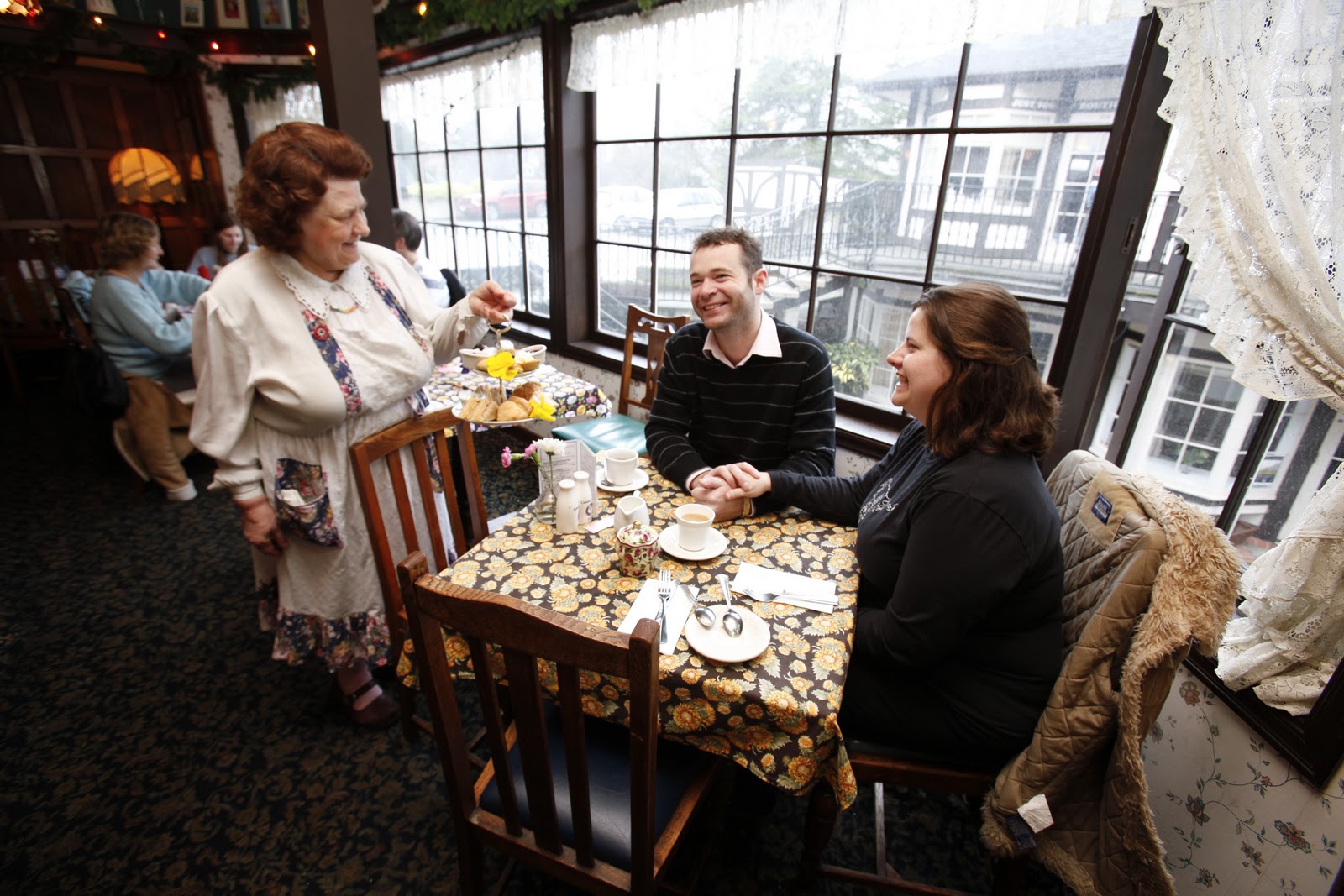
Eating at the Blethering Place was like visiting your dotty aunt for lunch. Photographs by Deddeda Stemler.

By Tom Hawthorn
Special to The Globe and Mail
January 31, 2011

VICTORIA

The Union Jack has been lowered over the Blethering Place Tea Room for the final time.

The banner flew over a landmark restaurant in Oak Bay, a municipality whose borders are teasingly described as the Tweed Curtain.

The Blethering Place, where tour buses stopped and the Galloping Gourmet recorded two episodes of his television cooking program, served its last scone and poured its last cuppa on Sunday.

After three decades of helping convince American tourists that Victoria is an outpost of Merry Olde England, the owner is closing the doors. The city’s “favourite faux Tudor tearoom,” as it has been called, is to be replaced by new owners who have in mind a modern bistro.

“It was an oasis,” said Ken Agate, the 66-year-old proprietor who lives in an apartment above the restaurant overlooking Oak Bay Avenue, the local High Street. “It’s not about being fine dining. It’s about being comfortable and welcome.

“It wouldn’t matter if you sat here all day. You can bring the baby. You don’t need a reservation. You don’t even have to eat.”

The restaurant has been packed this week, as old-time customers returned to sample such dishes as Welsh rarebit, shepherd’s pie, bangers and mash, and a breakfast item billed as “eggs Benedict Arnold.”

While online reviews of the cuisine can kindly be described as mixed, the room earned accolades over the years from travel writers for the Seattle Times (“beloved and venerable”) and the Los Angeles Times (“lots of local ‘old ducks’ chattering away”).

Diners sat in a room filled with such bric-a-brac as dolls and lesson books, toffee tins and biscuit boxes, packaging for blancmange and mushy peas. A portrait of Winston Churchill shared a wall with two Union Jacks.

The decor consisted of “oak panelling, lace curtains, seersucker tablecloths,” the New York Times once noted, while the clientele “look as if they have emerged from the background of an Agatha Christie mystery novel.”

Tea was served in pots covered by crocheted cozies. It was like eating at your dotty aunt’s place.

Mr. Agate bought the restaurant on a whim. He saw the tea room, thought, “I could do that,” and walked in to buy the business. The owner declined, but that very night Mr. Agate got a call from the owner’s wife. Over time, Mr. Agate expanded the space to take over an adjacent grocery and realtor’s office.

He had not been a restaurateur before taking over the tea room, though his family had dairy expertise. Mr. Agate was born in the Fijian coastal village of Navua, where his father introduced ice cream to the tropical archipelago. He grew up in Palmerston North on New Zealand’s North Island, where an early job at a department store led to work as a traveling salesman. He married a hairdresser and eventually owned three salons, which were sold to finance a relocation to Vancouver Island.

He took over the restaurant on the first day of 1981, when, as he puts it, “I got into the beautiful rut of the Blethering Place.”

The tea room took its name from a Scottish word for “voluble senseless talking.”

One day, he spotted among the diners Graham Kerr, the popular cook known by his television audience as the Galloping Gourmet. Mr. Kerr had begun his media career in New Zealand, so the two hit it off, and soon after two episodes for the chef’s syndicated program were taped in the tea room.

The tea room shared a block with such businesses as the Penny Farthing pub and the Tudor Sweet Shoppe, which contribute to the neighbourhood’s sense of British heritage. Yet, Oak Bay’s exclusive Uplands neighbourhood was designed by American landscape architect John Charles Olmsted, while other subdivisions were planned according to principles outlined by American sociologist Clarence Perry.

The Union Jack that once flew over the restaurant, shredded by winter winds, has found a home in Washington state. A vexillologist in the city of Battle Ground, north of Vancouver in Clark County, collects distressed banners. The Union Jack is tattered by weather, not war, an appropriate keepsake for Battle Ground, which takes its name for a site on which an anticipated battle did not take place.

The Blethering Place, where tour buses stopped and where Graham Kerr taped two episodes of The Galloping Gourmet, was a landmark on Oak Bay Avenue.