Tuesday, December 6, 2011

Goldsmith's voice remains untarnished

Hans Stamer fires up a jewelry tool in his Vancouver shop. His rock band wowed the critics, but he has returned to his roots in recent years by recording an album of jazz ballads. Darryl Dyck photograph for the Globe and Mail.

By Tom Hawthorn
Special to The Globe and Mail
December 1, 2011

Hans Stamer crafts by hand his own jewelry designs.

“It’s something I’ve been doing all my life,” he said in an accent that betrays his German birthplace even after a half-century in Canada. He turned 73 earlier this month. “It makes me a fairly good living, even at my age.”

He makes bracelets and brooches, engagement rings and wedding rings.

“A lot of times when I finish a piece and it is handed to the lady who is getting married to the gentleman, I get a big hug,” he said.

He also has on offer in his shop compact discs tucked inside jewel cases. For many years as a young man, he abandoned the jeweler’s workbench for the concert stage, put aside a craftsman’s tools to instead hold a microphone. This was one goldsmith who sought to make a gold record.

Mr. Stamer (pronounced STAY-mer) began an apprenticeship at age 16 in his native land, taught by master goldsmiths in skills that trace their roots to the ancient Phoenicians. He was early into his training in Hamburg when he attended a concert by the great jazz trumpeter Louis Armstrong.

“Louis was the king,” Mr. Stamer said. “He blew our minds. I said, ‘I’m going to sing like that some day.’ ”

(The 1955 concert is notorious in the annals of jazz, as the performance ended in disarray when youths rioted after the amplifying system went on the fritz. Chairs were smashed and broken pieces thrown at the stage of the Ernst Merck Hall. Twenty-three rowdy concertgoers were arrested. The New York Times ran a front-page story days later with the headline: “United States has secret sonic weapon — jazz: Europe falls captive as crowds riot to hear Dixieland.”)

Mr. Stamer caught many acts that toured through Hamburg, including a rocking group from Liverpool who appeared at clubs along the Reeperbahn. Not long after he moved to Canada, he was surprised to see the Beatles on the Ed Sullivan Show. He had been unaware of their startling rise in popularity.

In Edmonton, he fronted a group called The Famous Last Words, a hard-driving blues outfit. In front of a microphone, Mr. Stamer lost his accent, transforming himself into a raspy-voiced, hand-clapping son of the Southern soil. He was “a boy from Hamburg who sounded like he was from the Mississippi Delta,” said Al Girard, the group’s drummer.

Mr. Stamer then wound up in Quebec as lead singer of the Backstreet Dudes, replacing Chan Romero, the author of Hippy Hippy Shake, who had abandoned the band after finding God one Christmas while at home in Montana. The Dudes renamed themselves Phoenix of Ayer’s Cliff, after an Eastern Townships village, and toured the United States.

After the group disbanded, Mr. Stamer returned west, landing in Vancouver, where, in 1969, he joined Django, which had a regular gig at The Parlour, a small club without a liquor license at Pender and Main. The quintet, featuring the spectacular stylings of guitar wizard Gaye Delorme, shared a house near Jericho Beach, spending a part of each day in meditation. They placed lit candles and flowers around the stage while performing. (Mr. Delorme died earlier this year, aged 64.)

By the early 1970s, Mr. Stamer had formed his own eponymous band, changing the spelling of his name to Staymer at the urging of the record company. He also released a full long-playing record with an album cover featuring him rubbing a washboard. “The cuts virtually sizzle and sputter with a form of musical and vocal intensity that is indeed a delight,” the music-industry magazine Billboard stated in a review. The single Dig A Hole got scattered airplay across Canada and the U.S.

The band signed with RCA Canada and opened for the likes of James Brown, Tina Turner, and Bachman-Turner Overdrive. A second album was praised for “a loose, easy-rolling funkiness” by Jim Millican, a reviewer for the Canadian Press.

A full-page advertisement appeared in Rolling Stone. The band was preparing to go to San Francisco for a show, where they were to meet Ralph J. Gleason, the influential jazz and rock critic.

The visit was cancelled when the critic died suddenly.

“One of those breaks,” Mr. Stamer said.

Soon after, the label lost interest.

“Nobody knew what to do with us and the whole thing fell apart.”

The singer returned to his old craft. He did not give up music entirely, performing around Vancouver with the R&B Allstars, a well-regarded outfit with as many as 10 players who were known for wearing formal white tuxes, “a real whoop-de-doo show,” Mr. Stamer said.

He opened a shop, only to abandon street-level retail after being pepper-sprayed by a thief.

In 1998, Mr. Stamer earned a Juno Award nomination with Bill Bourne and Andreas Schuld for best blues album for No Special Rider.

The award went to Colin James, the younger Vancouver bluesman.

There were no hard feelings.

When Mr. James got married, it was Mr. Stamer who crafted the wedding rings.

Two years ago, Mr. Stamer at last recorded the album he had in mind ever since seeing Louis Armstrong all those years ago. The title track of Everything Happens to Me shows the goldsmith’s voice has not tarnished over the years. This record is gold in everything but sales.

Michael Magee, actor, horse-racing analyst (1929-2011)

Michael Magee in character as the cracker-barrel philosopher Fred C. Dobbs.

By Tom Hawthorn
Special to The Globe and Mail
November 30, 2011

In a three-piece chalk-stripe suit, the farmer Fred C. Dobbs railed against political perfidy and bureaucratic stasis. With tumbleweed eyebrows and a soup-catching mustache, his hair as disheveled as the bristles on a barnyard broom, Dobbs expounded on his philosophy with the subtlety of an Old Testament prophet.

“If the Lord had meant for us to go metric,” he pronounced, “He’d have given us 10 apostles.”

Such were the sayings of the cantankerous Dobbs, the self-proclaimed sage of Beamsville, Ont., a cracker-barrel philosopher who challenged Bay Street from Main Street.

Dobbs was the alter-ego of Michael Magee, who has died, aged 81, after a long struggle with colitis, which ultimately led to heart failure. The actor had a long career in radio and television, where he also enjoyed great success as an analyst of thoroughbred horse races.

“Michael Magee is as enthusiastic about racing and its future as anyone I’ve ever known,” the industrialist and celebrated horseman E.P. Taylor once wrote. “It would be fair to say that he is having a lifelong love affair with the sport.”

Where an older generation was familiar with him as a curmudgeonly sage, or as an evaluator of horse flesh, a younger generation rooted against him as the voice of the dastardly Cyril Sneer in the popular animated series The Raccoons.

Magee was born on Oct. 11, 1929, a fortnight before cascading days of panic selling led to the Wall Street crash, plunging the world economy into depression.

His parents belonged to the Ontario Jockey Club, which was headed by Taylor, one of Canada’s wealthiest men. Taylor’s mother was a Magee and the industrialist was Michael Magee’s uncle.

At age 12, Michael criticized his parents’ passion for horse racing. His father challenged him to learn about a subject before offering a critique. The boy then became a regular at the track, a refuge during what would prove to be a tumultuous tenure at a series of private schools in Ontario.

As a teenager, he worked as a money runner for the mutuels department at the original Woodbine track in east-side Toronto, before taking a similar job at Exhibition Park in Vancouver. In 1956, he became a partner in Triangle Stable, whose lone racer was the filly Brighton Queen, named for an English Channel paddle steamer. Magee joked that she was slower even than her namesake.

That same year he debuted on radio station CKNW, based in New Westminster, outside Vancouver. His daily feature on the It Could Happen Show included a simulation of a fictitious horse race complete with cheering and faked public-address announcements.


“I’d dramatize a race before it was run, as I thought it would be run, speedsters setting the pace and so on,” he once said, “but I’d make sure the winner would be the one I was tipping that day.”

Magee spent nearly a half-century on the radio talking about the Sport of Kings, including stints on CBC Radio, CKEY, CKO and The FAN, where, in 1994, he began co-hosting a Saturday program during the racing season called Racing With Magee. He was also a familiar commentator on CBC television broadcasts of such prestigious races as the Queen’s Plate.

As a young man on the West Coast, he worked as a janitor, a surveyor, a hotel desk clerk, and on the line of canning factory, “crummy jobs,” he once acknowledged to an interviewer, “all designed to free me to go to the track in the twilight hours.”

Magee also launched a stage career, notably as a solo performer in the challenging, one-act Samuel Beckett play, Krapp’s Last Tape. The first quarter of the 80-minute play includes no dialogue.

“It is due to the work of actor Magee that the lurid and lucid picture of a man kept alive by the descriptive excesses of his past gets across as vividly as it does,” the Vancouver Sun noted in an unsigned review.

Magee did not last long on the stage.

“You starve acting,” he said, “and you need money to go to the races.”

He returned to Toronto in 1962 and three years later was co-host of a public-affairs program out of Winnipeg called The View From Here.

The Dobbs character was introduced to a national audience in 1968 on Gerussi: Words and Music, a mid-morning CBC Radio show hosted by Bruno Gerussi. The popularity of the crusty character led to a slot the following summer as a 10-week holiday replacement for The Max Ferguson Show.

It was while working as the overnight cleanup man at a Vancouver hotel that Magee conjured a character who mistrusted politicians and bureaucrats, big labour and big business.

“All the old ‘lobby generals’ used to congregate there and talk, and I used to listen to them,” Magee told the Toronto Star in 1969. “Fred is based on those guys, and on the old guys that hang around race tracks. They’re honest and opinionated, and they’ve got guts. You see an old guy walking across the street and a car pulls up short and the driver honks his horn at him. The old guy is liable to bring his walking stick crashing down on the hood of the car. Can you see a doctor, or a lawyer, or a guy from McLaren’s advertising doing that?”

The name Fred C. Dobbs was freely borrowed from the main character in the B. Traven novel, Treasure of the Sierra Madre, popularized by a 1948 movie starring Humphrey Bogart as Dobbs.

Dobbs also appeared weekly on Ottawa television as a parliamentary correspondent from Beamsville before making his national television debut with Don Harron on a 1969 New Year’s Eve broadcast, That’s the News??? Good Night!!! The Star called it “CBC’s best TV comedy special ever,” while Magee was heralded as the comedy find of the year.

The duo again paired a year later in Wring Out the Old, which the same critic, Patrick Scott, described as the disappointment of the year.

In 1969, Magee hosted a television show shoehorned in the remaining time left in a half-hour slot at the conclusion of Hockey Night in Canada. The show, Champion, profiled a Canadian athlete.

The comic’s acidic take on hypocrisy found expression during a pilot episode of a series titled True North during which Magee angrily denounced Canadians for a placid, colonial mindset. “For America, Canadian water,” he complained. “For China, Canadian wheat. For Russia, Canadian hockey. For Canada, Canadian mewing, whining and puking.”

Magee paired with his wife, Duddie, a former secretary, on The Real Magees, a half-hour midday talk show. Guests on their debut week in 1973 included a taxi driver, a nightclub bouncer, and a fortune teller who informed the couple they were not suited for one another.

The couple “argue with each other with the most incredibly bad taste,” Helen Worthington wrote in the Star. “Who needs it? This, most of us can get at home without turning on the TV.”

As well as appearing together on television, the couple owned and operated a meat market on Church Street in Toronto, for which they imported dulse seaweed from the Maritimes and sold sauerkraut from a barrel.

The Dobbs character continued to delight audiences as one of a parade of Magee creations appearing on Magee and Company, a satirical, 15-minute show that ran on TVOntario and developed a cult following. Magee showed off a cast of characters, including The Pastor, Baunston Tudball, and J. Carter Hughes, chairman of the Dominion Gas and Screw Co. Ltd., a businessman who served as a foil for Dobbs.

Magee as Dobbs authored a humour book, titled The Golden Age of B.S. (1977), which was favourably reviewed in the Globe by Ontario premier William Davis, who proclaimed the character to be “honest, direct, frustrated and appealing.” This was followed by a sequel, The Platinum Age of B.S. (1981). Magee also wrote Champions, reviewing the careers of 17 thoroughbred winners from the 1970s, a golden age in horse racing. The book featured 80 colour images by the Toronto photographer Pat Bayes.

Dobbs became so popular a figure that he was once billed as a speaker at a Toronto conference with the likes of Peter Gzowski, Marshall McLuhan and John Diefenbaker. He also appeared in the Merry Posa Review during the annual Leacock Festival of Humour at Orillia, Ont.

In 1983, Global aired an hour-long comedy special, Fred C. Dobbs Goes to Hollywood, during which the curmudgeon joined country singer Hoyt Axton, met a Burt Reynolds lookalike, and watched as William Shatner polished his star in the sidewalk at Hollywood and Vine.

In time, the Dobbsian sense of humour came to be less universally appreciated. He was the after-dinner speaker at a conference of the Writers’ Union of Canada when his comments, including a description of his fictional wife as “the old mattress,” led some members to exit. Years later, he dismissed the incident as “four women with mustaches walk(ing) out,” a bitter reaction that did not reflect well on him.

In 1976, Magee lost a suit for damages for wrongful dismissal after he said he was replaced as host of a public-affairs show on Toronto’s CITY-TV. An Ontario Supreme Court judge ruled that while Magee had an oral contract with CITY president Moses Znaimer, the conversation took place on a Sunday, contravening the Lord’s Day Act.

His lengthy list of credits includes an appearance as a baffled police inspector in David Cronenberg’s The Brood, a horror film about mutant children.

In 1980, Magee voiced Cyril Sneer, a cigar-chewing aardvark who is the villain of The Christmas Raccoons, an animated special featuring voices by Rich Little and the singer Rita Coolidge as well as hockey play-by-play by Danny Gallivan. The Raccoons later aired for several seasons as a popular children’s series. Magee modeled Sneer on a schoolmaster under whom he had suffered.

One of his odder gigs involved serving as master of ceremonies for a fundraiser for John Crosbie, who incurred a $200,000 debt in an unsuccessful campaign for the federal leadership of the Progressive Conservatives in 1983. Others on the bill included the pianist Andre Gagnon, singer Helen Reddy and Playboy playmate of the year Shannon Tweed, who was born in Newfoundland, as was Crosbie, who currently serves as the province’s lieutenant governor.

Magee produced several institutional films for the Canadian Trotting Association, as well as features on such horses as Nijinsky and Secretariat. He won a journalism prize for a documentary on the trotter Armbro Flight. He also earned an ACTRA (Association of Canadian Television and Radio Artists) award nomination for documentary writing for his work on True North.

His great passion for the turf led to horses being named after him, including Michael Magee by Dacotah Stables in Manitoba, as well as Ontario-bred Fred C. Dobbs, a stakes winner as a two-year-old.

Despite having evaluated thousands of horses over the years, their tendencies and pedigrees committed to memory for live broadcasts, Magee never forgot his first winning bet, placed at Thorncliffe Park Raceway at Leaside, Ont., later absorbed by Toronto. Years later, he would recall with delight a horse named Isbright.

Magee, a resident of Caledon, Ont., died on July 15 at Grand River Hospital in Kitchener, Ont. He leaves Sally Hamilton, his companion of 26 years.

With hard work and groundwork, rookie politician wins his first election

George Anderson relied on hardworking volunteers and social media to get his message across to Nanaimo voters. The 20-year-old won election to city counci and will be a politician to watch. Geoff Howe photograph for the Globe and Mail.

By Tom Hawthorn
Special to The Globe and Mail
November 28, 2011

VICTORIA

George Anderson showed up for an evening’s bowling with his right index finger heavily bandaged after an incident with a sledgehammer.

In solidarity, his companions decided to bowl with their weaker hand.

As the pins fell, his phone buzzed with calls and messages.

He apologized, but left early. He needed to get to the Shaw Auditorium in downtown Nanaimo.

It was election night and Mr. Anderson was among 22 candidates vying for eight spots on Nanaimo city council.

An earnest, well-spoken student, Mr. Anderson juggles part-time jobs while studying biology and criminology at Vancouver Island University. He will decide on law or medical school later this year. A busy schedule always includes charity work.

Without a hint of insincerity, he speaks of love for his birthplace of Nanaimo, a community not known for inspiring paeans.

When the ballot count ended, Mr. Anderson had 7,450 votes to finish in fourth place, ahead of seasoned incumbents.

Just three years removed from high school graduation — he was class valedictorian at John Barsby Secondary — this Canadian-born son of Ghanaian immigrants earned a place on city council.

“I still live at home,” he noted. “Now I can have my parents yell at me about their property taxes.”

Mr. Anderson operated an insurgent campaign online and on the streets of the Hub City. On occasion, his volunteer team met at the Tim Hortons at 1812 Bowen Rd.

He posted an impressive, one-minute campaign video on YouTube.

“We can no longer be a city that is business versus residents, north versus south, new-timers versus old-timers,” he says in the video. “We need to come together and build upon a collective vision that each and everyone of us can be proud of.”

The message owes more than a little to the optimism of a recent presidential campaign. His own platform included such uncontroversial stands as calling for a stronger business community. If the rhetoric was less than meaty, the Anderson campaign made up for it through the gritty work of knocking on doors.

The candidate himself lost count after 2,000. (He was distracted by midterms midway through the campaign.) He even made a point of canvassing little Protection Island, where residents told him they had not before had a politician on their stoop. “People really liked that I was able to come and talk to them,” he said.

In the end, his 62 votes led the island’s poll.

The campaign spent under $5,000, less than a dollar per vote.

About the only misstep came when his financial agent accidently mashed his finger with a sledgehammer as they tried to erect a homemade sign.

The finger was fractured, but the doctor assures him he will be able to return to playing the piano. As well, he leads an eponymous jazz trio, and also plays tuba, trumpet, and alto and tenor saxophone.

Mr. Anderson has been a postal clerk, a customer service representative, and a “sandwich artist” for a fast-food chain. In this year’s federal election, he held a position as a youth outreach worker for Elections Canada. Now he can add councillor to an impressive resumé.

He decided to run in June, having closely followed civic politics for several years. A controversial severance package paid to the retiring city manager was among the issues that convinced him to enter the race.

John Ruttan, the re-elected mayor, told the Nanaimo Daily News that he considered the youngest addition to council to be “bright and articulate.”

Mr. Anderson counts among his political inspirations Wilfrid Laurier (“someone who wanted to pull our country together”), Robert Borden (“who brought the government together in a time of war”), and Tommy Douglas (“who helped father our health-care system”).

“In everything I’ve tried for, I tend to win,” he said. A rare exception: He lost a race for student council when in Grade 6 at Park Avenue Elementary.

His father, Nicholas, is a machine operator for PostMedia, while his mother, Elizabeth, is a collator for Black Press. George is the youngest of four children. His parents taught him that he should be polite even should he be disliked solely for reason of his ethnicity.

“People want to put people in boxes. I don’t think that’s right,” he said.

In high school, he found his straight-arrow image challenged stereotypes.

“Just because I look a certain way I’m supposed to act a certain way,” he said. “I don’t think I should have to wear baggy pants, or have my teeth look ugly and have a do-rag on. I’m George Anderson and I should be able to be the way I want to be.”

He has been involved with Big Brothers Big Sisters, helped organize a summer camp for poor children, conducted a symposium for high schoolers on drugs and mental health. Every yuletide, he rings Christmas bells as part of the Salvation Army’s kettle campaign.

On Friday, though, Mr. Anderson took a rare day off. He had good reason. It was his 21st birthday.

Former Miss B.C. Lions went on to be hailed as a hero

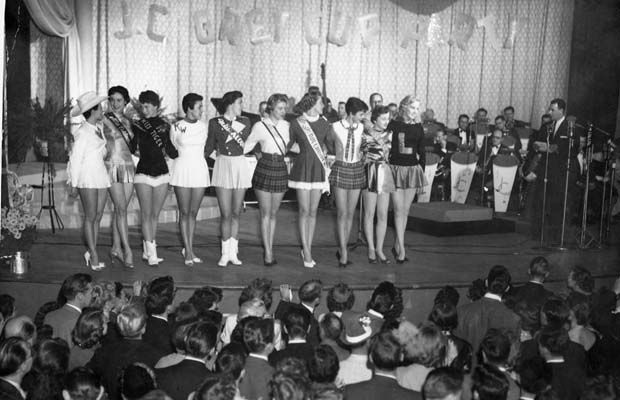
The contestants for the 1955 Miss Grey Cup pageant line up on stage in Vancouver. Glenda Sjoberg, the 18-year-old Miss B.C. Lions, is on the far right wearing a sweater with the letter L on the front. The crown went to Miss Edmonton Eskimos. 

By Tom Hawthorn
Special to The Globe and Mail
November 24, 2011

The Grey Cup parade featured clowns and cowboys; marching bands and baton-twirling majorettes; Mounties in Red Serge, a smart Stetson on each head, and Shriners in silky harem pants, a silly fez on each head.

In 1955, on the cusp of the first Grey Cup football championship to be played on the West Coast, tens of thousands lined the neon-lit streets of downtown Vancouver for a glimpse of the spectacle.

A procession of horses and tractors and colourful floats paraded past. There was a grizzled prosector with a mule and an inexplicable Saskatchewan display featuring a man in a football costume shoveling wheat over his shoulder onto the blacktop.

An open convertible carried Marilyn Bell, who was cheered by the throngs a year after the teenaged swimmer conquered Lake Ontario.

Towards the end, a young woman wearing a sweater in the black-and-orange livery of the local football team waved to the crowd while sitting atop the trunk of a convertible.

This was Miss B.C. Lions, a beauty queen selected to represent the team in the contest to be named Miss Grey Cup.
Miss Grey Cup escorts the trophy at 1955 parade.
Glenda Sjoberg, known as Goldie for her lustrous locks, was an 18-year-old logger’s daughter from Nanaimo. According to the newspapers, she was “Glamorous Glenda,” a “comely,” “charming,” “beautiful,” “tall, blue-eyed blonde.” She had won a local beauty pageant to become Miss Nanaimo before defeating 22 other contestants to become Miss PNE (Pacific National Exhibition).

She won a gold compact, a white Arctic fox fur shoulder piece, and a carved hardwood salad bowl from the British West Indies. Officials presented her a cheque for $1,000, which she said would be used to pay for treatments for her mother, Olga, bedridden with arthritis.

As Miss PNE, Miss Sjoberg automatically became Miss B.C. Lions, making necessary a crash course in football, a sport about which she knew little.

In the end, she did not win the Miss Grey Cup title, which went to Miss Edmonton Eskimos. The Eskimos were also successful on the gridiron, defeating the Montreal Alouettes, 34-19, to claim the trophy. Empire Stadium was packed with 39,417 paying customers, a Grey Cup attendance record that would stand for 21 seasons.

For a young woman from Vancouver Island, her reign as a local pageant queen was a whirlwind of adventure. (But not too much adventure. She was chaperoned by a family friend.) She did not entertain visions of trying to break into movies.

“Hollywood? No thanks,” she said at the time. “That kind of life just isn’t for me.”

After the game, she returned to the anonymity of life as a dental assistant on Vancouver Island.

A few years later, she graduated from a course for stewardesses conducted by Trans-Canada Air Lines. They issued a press photograph to promote their hiring of a former Miss B.C. Lions.

Miss Sjoberg had been on the job less than a year when she would need to call on all her training.

On Oct. 3, 1959, she was aboard a Viscount airliner on approach to Malton airport, outside Toronto, in a blinding rainstorm. The stewardess was handing out hats and jackets to the passengers when intuition led her to quickly take her place in a rear-facing jump seat. Just as she was about to buckle the seatbelt, the plane touched down hard before becoming airborne again.

Short of the runway, speeding along at 120 m.p.h., the plane clipped a light pole, ripped off barbed wire atop a fence surrounding a covered reservoir, bounced into the air, narrowly missing a transformer, before skidding over a ditch and across a road and over another ditch, then tearing down a section of the fence surrounding the airport before coming to a thudding halt, the fuselage cracked in half.

“Wham, bam, crash,” the retired stewardess remembered on Tuesday. “The lights went. There was dust and dirt.”

For a moment, there was also silence.

A woman cried out. She had been holding twin baby girls in her arms and both had slipped from her grasp on a hard bounce. The infants were found beneath the seats, unharmed.

Miss Sjoberg ensured the passengers and crew were evacuated before going for help.

“I’ve got no shoes on and it’s raining,” she said. “What am I going to do? I’m not going to go looking through metal and mud for them.”

She made her way in stocking feet to a nearby service station, telling them to call for an ambulance. Then she returned to the plane to assist three fellow crew members and 36 passengers. Among them was Ward Cornell, the sports announcer who was about to make his debut on Hockey Night in Canada.

Four went to hospital with injuries, including the pilot and the other stewardess. All survived.

“Everybody” she said, “was very lucky.”

Some contemporary accounts hailed her as a hero.

The crash was blamed on wind sheer. The turboprop was a write-off.

The following year she married Pete Kinzie, a pilot. She had to quit her job, as married women were not allowed to work as stewardesses in those days.

She enjoyed the work, and now remembers happily the pleasures of passenger flight in those days. She has yet to see an episode of the period drama Pan Am.

She traveled the world with her husband before settling in Burlington, Ont., where today a 75-year-old retiree can barely believe she was once Miss B.C. Lions.

“I was not a beauty-pageant type,” she said. “I did it for my mother.”

This Trans-Canada Air Lines Viscount landed short of the runway at Toronto's Malton airport in 1959. It skidded along the ground along the length of several football fields. All 40 passengers and crew survived, including a stewardess who had been a beauty queen.

Election winners: A poet, a prosecutor and a partier in a Prius

Dean Fortin won easy re-election as mayor of Victoria, though two incumbent councillors he endorsed endured a surprising defeat. Chad Hipolito photograph for the Globe and Mail.

By Tom Hawthorn
Special to The Globe and Mail
November 21, 2011

VICTORIA

Scenes from an election:

The news left John Luton crestfallen. He had lost his seat on Victoria city council. At 57, he wondered aloud about his future employment.

“I’m not afraid of hard work,” he said, before noting, “It’s a time of life when it can be very hard to find a job.”

All around him, people were celebrating the re-election of Victoria mayor Dean Fortin and two members of what was billed as Dean’s Team — councillors Pam Madoff and Marianne Alto. Mr. Luton and Lynn Hunter, a former member of Parliament, were two members of the team who lost their re-election bids.

Mr. Luton lingered at Mr. Fortin’s victory celebration at the Union Pacific Coffee Co. to thank volunteers.

He was in the midst of contemplating his future when interrupted by Ben Isitt, 33, an academic and author who had just won election to council.

Mr. Isitt grabbed his right hand.

“You were the part of the Dean Team that I most wanted to work with,” Mr. Isitt said.

As they continued their exchange, the ebullient Mr. Isitt pumped Mr. Luton’s hand again and again.

Mr. Luton offered a wan smile. He then put on his helmet and reflective vest to cycle home alone in the dark.

* * *

Victoria is still small enough that some campaigns operate from the kitchen table.

After the polls closed, Victoria councillor Charlayne Thornton-Joe and her husband Phil, a longtime bus driver, parked on a street in Chinatown around the corner from where her family once operated a store selling caulk boots to loggers. (It is now a tattoo parlour.) The couple listened to the results on the radio.

After her re-election was announced, they held a two-person victory party in their Prius. Then, they got out and walked a block to join the throng at the Fortin celebration.

***

The other two new councillors in Victoria are restaurateur Shellie Gudgeon and Lisa Helps, whose name doubles as a campaign slogan.

* * *

In neighbouring Oak Bay, a pleasant municipality described as being behind a Tweed Curtain, the seasonal pleasures of leaf-raking and strolling a high street redolent with roasting chestnuts have been disturbed by the unseemliness of a competitive electoral race.

Mayor Christopher Causton, who lost a campaign for a seat in Parliament earlier this year, decided to retire after 15 years of wielding the gavel at council. Mr. Causton was known for showing up on the doorstep of every new resident to bring them official greetings.

His retirement pitted council veterans Nils Jensen and Hazel Braithwaite in a contest for the mayor’s chair.

A major issue in the race — nuisance deer.

Mr. Jensen, a Crown prosecutor, defeated his council rival by 3,197 votes to 2,769.

His campaign website features an impressive resumé, yet neglects to mention his foray into provincial politics. Though not known as a New Democrat, Mr. Jensen emerged as a challenger for the provincial party leadership eight years ago. On the first ballot, he finished second to eventual winner Carole James.

The Oak Bay council poll was topped by Tara Ney, the daughter of the late Frank Ney, a swashbuckling mayor who dressed as a sabre-waving pirate to promote the bathtub races that made Nanaimo famous. Ms. Ney is more superhero than buccaneer — she once earned a commendation from the Governor General for alerting a neighbouring family to a house fire. Among the achievements listed on her website was convincing the local Starbucks to open early at 5:30 a.m. so that she could begin her day’s work.

* * *

In Saanich, Frank Leonard held on the mayor’s chair despite a stiff challenge from former NDP MLA David Cubberley. Fun fact: Mr. Leonard’s infant son with Jackie Ngai, a former councillor, is named Atticus. Atticus Finch is the lawyer hero of Harper Lee’s novel, “To Kill a Mockingbird.”

* * *

Paul Reitsma once again placed his name before the voters of Parksville, where he served as mayor from 1987 to 1996 before winning election to the Legislature.

“I think that those without some baggage have not traveled much on life’s journey,” he said during the campaign.

As a Liberal MLA, he had been caught by the local newspaper writing letters to the editor under fake names. The exposé generated the most memorable headline in recent B.C. newspapering history: “MLA Reitsma is a liar and we can prove it.” He resigned on the cusp of becoming the first politician in the Commonwealth to be recalled by voters.

Mr. Reitsma comeback failed, as he took just 749 votes. Chris Burger won the mayoralty with 2,355.

* * *

Port McNeill mayor Gerry Furney, a poetry-writing Irishman who has held elected office in the Vancouver Island logging town for 43 years, held off a challenge from a councillor. Furney took 572 votes to Shelley Downey’s 394.

Last year, His Worship released “Popcorn for Breakfast,” a volume of rhyming verse. The title poem describes a hockey father seeking morning nourishment from arena vending machines:

“(O)f the junk food I ate there first/ Popcorn for breakfast was surely the worst./ The coffee was stale, the hot chocolate cold,/ Sandwiches tasteless except for the mould.”

He’s also written about logger’s equipment: “It’s sad that men in fancy suits/ Don’t know much about caulk boots.”

He’s no Seamus Heaney, but he has a certain North Island charm.

Monday, December 5, 2011

Fotheringham a lucky man living with tragedy

Allan Fotheringham has penned a memoir of his journalistic career, ranging from his beginnings on the Ubyssey student newspaper to seeing the world on the publisher's dime. Rafel Gerszak photograph for the Globe and Mail.

By Tom Hawthorn
Special to The Globe and Mail
November 16, 2011

VICTORIA

An obituarist does not often get to meet his subject four years after the assignment, but here was Allan Fotheringham, hale and hearty at 79.

The self-described “humble scribe” is on tour to promote his ninth book, the first in a decade and a return to form after an escalating series of ailments and medical mishaps left him near death in 2007.

Thinner, his voice reedier from damage to vocal cords caused by a breathing tube, he still carried on his face a familiar, smart-aleck impishness.

On a quiet fall afternoon, an attentive audience filled 70 chairs in a room at the central branch of the Victoria library, seeking a few moments with a writer who has been poking the pomposity of the powerful for more than four decades. Most had aged with him, from the must-read column in the Vancouver Sun, to 27 years of caustic commentary at Maclean’s, to being a wiseacre on a prime piece of real estate in the Globe, to many seasons of wit and irreverence on television’s Front Page Challenge.

“Even I cannot believe the life I am living,” he said.

Dr. Foth, as he also describes himself, read two anecdotes from his memoir, one about the marriage of Pierre Elliott Himself (a coinage known as a Fothism). The other was about another prime minister replacing the first syllables of the columnist’s family name with a venerable expletive in verb form. When an editor removed the swear word in an earlier book, Mr. Fotheringham slowed book signings by turning to the offending page to scratch out his name to replace it with the vulgarity. The crowd howled at the story.

His wife collected $32 cash for each copy of Boy From Nowhere, which he then signed. Some of the audience brought with them ancient copies of a magazine from whose pages he disappeared eight years ago. He was praised for using such phrases as “the Excited States of America.”

It was like witnessing a solo rock act, long fallen from the charts, being feted on a nostalgia tour.

“Gratifying doesn’t express it all,” he said. “It’s amazing. As I said, it took me 79 years to write this book. All the twists and turns in 91 countries, (trips) paid for by somebody else, I’ve had a remarkable life.

“I’ve got my health back and play tennis three mornings a week at 9 a.m., after almost dying four years ago. I’m the luckiest bugger around.”

Except when he isn’t.

He was in the final editing stage of the manuscript in late June when he received terrible news from overseas. His eldest son, who had been living in South Korea for seven years, had died suddenly.

“He was the bravest man I ever met,” Mr. Fotheringham said. “As a child, he was diagnosed with epilepsy. He had to take 20 pills a day to lead a normal life. He tried to follow his father and travel the world, not by expense account like me, but on a bike.”

The younger Fotheringham spent three month following the ancient silk road across Asia, a 4,800-kilometre cycling odyssey that included encounters with Tajik farmers and Afghan tank commanders. He fired an AK-47 on offer from an arms dealer, managed to twice elude a long stay in the hoosegow after being arrested by Chinese authorities.

He recounted his adventures in a book, On the Trail of Marco Polo. As one reviewer noted, his writing combined Gen-X jargon with cool understatement, as in this passage about camping in the mountains: “This is the life I thought. I just hope I don’t roll over the edge at night into the river. That would bite.”

The reviews were generally favourable, though they all seemed to compare the son’s writing to the father’s.

Allan Fotheringham at the Ubyssey.
“A good little book,” says a proud father. “The reviewers weren’t very fair to it, because they said, ‘This is a pretty good book, but it doesn’t have the wit of his father, or it doesn’t have the political depth of his father.’ We never discussed it, but I’m quite sure that’s why he decided to move out of Canada. He could see that whatever he did as a journalist, he would be compared to his father.”

In Korea, young Fotheringham taught English as a second language and wrote several reading and vocabulary books for beginners.

He was a curious man, a good quality for a journalist, and while he liked adventure he had to be careful about his health. The end came unexpectedly.

“His heart just gave out,” he said. “He fell in the bathroom and was dead before he hit the floor. It was a tragedy.”

The loss “wiped me out for a couple of months,” Mr. Fotheringham said. “My wife, Anne, the strongest person you could ever meet, got me through it.”

Dr. Foth has funded an annual $20,000 scholarship in his son’s name for the top graduating student in English at the school in Seoul.

Brady Delbridge Fotheringham, named for the great Civil War photographer Mathew Brady, was 47.

A newspaper clipping of a rare Fotheringham defeat in a libel suit.

Tsunami debris needs to be treated with respect

Seattle oceanographer Curt Ebbesmeyer is an expert on flotsam, jetsam, and where a message in a bottle is likely to wash ashore. Dave Ingrham photograph.

By Tom Hawthorn
Special to The Globe and Mail
November 14, 2011

VICTORIA

In rough seas, the Coast Guard patrol vessel Sooke Post spotted an overturned boat about to be dashed onto rocks.

The battered craft was towed to Prince Rupert, where it was learned the damaged craft was the Kazu Maru. The dinghy had last been seen 18 months earlier when its owner, Kazukio Sakamoto, a retired civil servant, left for a day’s fishing. He was lost, presumed drown.

He had gone to sea from Owase, Japan. By strange coincidence, Owase and Prince Rupert were sister cities.

With the widow’s permission, the restored boat was placed on display at the local cannery museum before being moved to a waterfront park where it now stands as a memorial to sailors lost at sea. The widow and dignitaries from Japan attended the ceremony.

The story of the drifting dinghy is a lesson, as an entire fleet of Kazu Marus — and much, much more — is on the way to Vancouver Island.

The tsunami that devastated Japan in March washed to sea entire villages — cars, boats, houses.

Some of it sank. Much of it floated.

Some bits and pieces might already have washed up on the island’s rugged and isolated west coast.

Scientists predicted the debris would begin washing up on North America’s Pacific shore in late 2013, or early 2014.

Now, a prominent oceanographer recognized for his trailblazing work in studying the contents of spilled cargo containers — from Nike sneakers to a bobbing bunch of yellow rubber duckies — believes the first arrivals from the disaster are lapping at our coast.

Curt Ebbesmeyer, 68, of Seattle, is asking fishermen, holidayers, and beachcombers to be on the alert for items from the disaster. He urges any finds to be reported and recorded with photographs as an aid to further scientific studies on ocean currents. He is also calling on people to not treat what what washes up as garbage, or as a souvenir.

“When people find something, it isn’t just debris,” he said. “It’s a memento for Japanese families and their loved ones. It needs to be treated with great respect.”

Anyone finding tsunami debris is encouraged to contact the retired scientist through his Beachcombers’ Alert website at beachcombersalert.org, a not-for-profit site dedicated to tracking flotsam and jetsam.

“Don’t just burn it as debris. Get it, sequester it, go through it for any remains. Test it for radioactivity. Then think about disposal.”

Officials estimate 16,000 were killed in the earthquake and subsequent tsunami, while another 4,500 remain missing, likely swept to sea.

Earlier this year, he said of the aftermath: “If you put a major city through a trash grinder and sprinkle it on the water, that’s what you’re dealing with.” The debris field is as expansive as the state of California.

Scientists made their original prediction based on estimations of wind pull and ocean motion caused by the swift Kuroshio Current off Japan. Mr. Ebbesmeyer, who jokingly describes his expertise as driftology, has found that larger items act like sailboats in the wind.

Four years ago, two beachcombers discovered a red, 10-metre-long fishing buoy bobbing in the breakers off Copalis, Wash. The Japanese lettering gave a hint as to its origins. Turns out the buoy belonged to a fishing co-operative at Ginoza, a village in Okinawa. It had come unmoored during a super typhoon, crossing the vast ocean in 245 days.

The oceanographer asked his colleague Jim Ingraham to simulate a transpacific trajectory on a computer program known as OSCURS (Ocean Surface CURrent Simulator). The results show large debris can move much faster across the Pacific than previously thought.

“Twenty miles a day, 5,000 miles, eight months,” Mr. Ebbesmeyer said of the tsunami debris. “Eight months from March is November.”

The red buoy has been put on display in Ocean Shores, Wash. The Okinawan village mayor, two fishermen, and the consul general for Japan based in Seattle attended a ceremony at which the buoy, worth $30,000US, was presented as a gift. As well, the two communities became sister cities.

As tsunami debris reaches these shores, Mr. Ebbesmeyer said it is important to remember the reaction of the Japanese to the recovery and preservation of the red buoy and the Kaza Maru.

“Multiply that by a thousand times all along the B.C. coast,” he said. “Multiply each of those thousand times by three people who are going to want to come over to pay last respects.”

Cast your eyes to the sea. What the ocean swallows, it sometimes spits back.