Wednesday, February 23, 2011

Taking a bite out of Nicholson's 'hold the chicken' legend


According to urban legend, the famous diner scene in Five Easy Pieces was filmed on Vancouver Island. Not so. This is the Denny's alongside Interstate 5 at Eugene, Ore. But a Vancouver Island diner does appear in the movie's final scene. See below.

By Tom Hawthorn
Special to The Globe and Mail
February 23, 2011

VICTORIA

They’re handing out the Oscars on Sunday, which means 73-year-old Jack Nicholson likely will be seen leering from behind the dark glasses he wears even when indoors.

He’s had a dozen nominations as an actor, more than any other male performer. One of the movies that established his career was Five Easy Pieces, much of which was filmed on Vancouver Island.

He plays Robert Eroica Dupea, a classically-trained pianist alienated from his bourgeois background who drops out to kick around the seedier side. The movie’s tagline: “He rode the fast lane on the road to nowhere.”

Released in 1970, the movie is best remembered for a scene in which his character butts up against a land of inexplicable rules and an unthinking obedience to same. (It is not a stretch to see the scene as a metaphor for how America became embroiled in Vietnam.)

Dupea and three companions sit at a table in a diner. He politely gives his order to the waitress: “I’d like a plain omelette. No potatoes. Tomatoes, instead. Cup of coffee and wheat toast.”

“No substitutions,” the waitress responds, pointing to a notice on the menu.

He then tries unsuccessfully to order a side of toast. The pair jostle, each getting more frustrated by the moment.

“Okay, I’ll make it as easy for you as I can,” Dupea says. “I’d like an omelette — plain — and a chicken salad sandwich on wheat toast. No mayonnaise, no butter, no lettuce. And a cup of coffee.”

“A No. 2. Chicken sal san,” the waitress repeats, exasperated, through clenched teeth. “Hold the butter, the lettuce, the mayonnaise. And a cup of coffee. Anything else?”

“Yeah. Now all you have to do is hold the chicken, bring me the toast, give me a cheque for the chicken salad sandwich and you haven’t broken any rules.”

“You want me to hold the chicken, huh?”

“I want you to hold it between your knees,” he says.

“You see that sign, sir. Yes, you’ll all have to leave. I’m not taking anymore of your smartness and sarcasm.”

“You see this sign,” he snarls, sweeping four glasses off the table with his right arm.

The scene helped earn Nicholson his first Oscar nod as best actor, though he lost to George C. Scott’s five-star performance in Patton.

To this day, some insist the famous scene was shot at a diner north of Duncan. The humourist Arthur Black once wrote a newspaper column about visiting the Red Rooster Cafe, a roadside joint on the Trans-Canada Highway between Duncan and Chemainus. He describes a waitress, more kindly than the one portrayed in the movie, gently breaking the bad news to him — the chicken-salad-sandwich scene was not filmed at the cafe.

Turns out Mr. Nicholson made his splash at a Denny’s off Interstate 5 near Eugene, Ore.

The latter half of the movie is set in the San Juan Islands, but keen eyes will spot several Vancouver Island locales, including the Mill Bay ferry; a bar in which a map of the Saanich peninsula can be seen on the wall; Beacon Hill Park, where Nicholson’s character delivers a powerful monologue to his mute and dying father; and, a waterfront mansion, at 8080 McPhail Road in Central Saanich, about which the Nicholson character says, “This is a fine house.” The mansion was demolished eight years ago.

The Red Rooster Cafe does appear in the movie’s final scene. Driving a 1963 Mercury Monterey, Mr. Nicholson pulls into a Gulf gas station alongside which the cafe’s neon rooster sign can clearly be seen. When his girlfriend goes for coffee, Nicholson’s character abandons his car, his jacket and his woman to hitch a northbound ride aboard a logging truck.

A few years ago, the restaurant was demolished and replaced, as has been the gas station, cinematic landmarks now relegated to film and memory.

Before the demolitions, Ross Crockford, the author of Victoria: The Unknown City, tried to interest Cowichan Valley newspapers in the story. None bit.

“Seems like I was the only person who had concern,” he said.

The gas station’s owner told him he had never even seen the movie.

The Red Rooster’s blue-plate special was an item billed as Maryland Chicken — a fried chicken breast served with bacon and fried banana, drenched in cream gravy, with a corn fritter on the side. Accept no substitution.


The closing scene of 1970's Five Easy Pieces takes place at the Red Rooster Cafe on the Trans-Canada Highway between Duncan and Chemainus. Check out the flickering neon sign. The cafe and the gas station have been demolished in recent years.


Spot the location

Here are some Vancouver Island scenes from Five Easy Pieces:

Jack Nicholson holds up traffic at the Mill Bay Ferry, a stand-in for a Washington State ferry. Note the CAA sticker on the car driven by Susan Anspach.


A 1912 mansion in Central Saanich served as the Dupea family manse, set on an unnamed island. This house, at 8080 McPhail Rd., was demolished in 2003.


Jack Nicholson grabs a drink. Spot the outline of the Saanich peninsula on the map on the rear wall.


Jack Nicholson's character, the alienated Bobby Dupea, has a heart-to-heart with his mute and dying father in Beacon Hill Park.


Beacon Hill Park stands in for one of the unnamed San Juan Islands in a powerful scene from Five Easy Pieces.


In the movie's final scene, Jack Nicholson drives a 1963 Mercury Monterey into a Gulf gas station next to the Red Rooster Cafe on the Trans-Canada Highway north of Duncan, B.C. The cafe and the gas station have been demolished in recent years.

Monday, February 21, 2011

Street's namesake serves as local reminder of a faraway war

Nancy Mansell wore a red poppy and a silver cross bearing her son's name to a dedication ceremony in which a suburban cul-de-sac was named after her son, Myles Mansell, killed in action in Afghanistan five years ago.

By Tom Hawthorn
Special to The Globe and Mail
February 21, 2011

VICTORIA

A far-off war came to a quiet suburban neighbourhood on the weekend.

A pair of 105mm howitzers flanked the entrance to a cul-de-sac.

Artillery shells lined the street, while passage on a sidewalk was blocked by mortars.

Officers barked orders. Soldiers marched, stamping their feet in unison.

A military padre intoned a prayer.

In the chill of a winter’s afternoon, a lone bugler played “The Last Post” followed by a bagpiper droning a lament.
Bombardier Myles Mansell (1980-2006)

About 200 people, many in military uniform of green camouflage, witnessed a half-hour ceremony at an out-of-the-way intersection in Langford on Saturday.

One who attended was a mother who wore a red poppy and a silver cross on her cloth coat. The latter, formally known as a Memorial Cross, is an award one never wishes to receive.

It is a memento of loss and sacrifice.

Her cross bore the name and serial number of Myles Stanley John Mansell, a bombardier killed in action in Afghanistan five years ago.

Those have been tough years for Nancy Mansell, a mother who wears her son’s name on an award.

Joined by her husband, Alan, she travelled from their farm in the North Thompson, outside Barriere, to the family’s old stomping grounds, a once rural community now transformed into a bedroom community of the nearby capital city.

The Mansells returned to Langford for the unveiling of a memorial plaque and the naming of Myles Mansell Road in honour of their son.

“It’s important for us to know that others think of Myles. And remember Myles. We don’t want him to be forgotten,” she said, contemplating such an outcome. “Just a number.”

She greeted well-wishers with the courtesy of someone who has become accustomed to accepting the condolences of strangers.

Lillian Szpak, a Langford councillor whose husband, Robert, is a physiotherapist with the Canadian Forces, approached to shake her hand.

“Thank you for speaking,” the mother told the politician.

“There’s very little anyone actually can say,” Ms. Szpak replied.

“Just knowing that we’re not alone,” Ms. Mansell said.

“The community is there,” the politician said. “All the best to you.”

So it has been for the past five years, since the awful day when the family learned the terrible news and the country was told four young soldiers had been killed by a roadside bomb. Also lost were other fine men named Turner and Dinning and Payne. In their grief, the Mansells had the grace to send condolence notes to the other families.

There had been 11 casualties before their deaths on April 22, 2006. Now the grim total is 154 members of the Canadian Forces, as well as a diplomat, a journalist and two aid workers.

A young man who carried in his middle names those of grandfathers who fought in the Second World War will now be forever aged 25.

“He thought he could make a difference in Afghanistan,” his mother said. “He thought it was the right thing to do.”

A female reporter gently asked how she was coping.

“Are you a mother?”

The answer lingered in the chill air.

“You’re never totally happy again. Special occasions are difficult. A big loss. You can’t replace it. You can’t fill it. He was my baby.”

Myles Mansell was born on Aug. 5, 1980, which means his mother was pregnant with the youngest of her three sons when the Soviet Union invaded Afghanistan. The attack initiating a full-fledged counter-insurgency war against Muslim tribesmen, setting in motion events yet to have come to a conclusion. The Mansells are a family caught up in geopolitical machinations beyond their control.

“Didn’t pay too much attention in those days,” she said. “We didn’t pay that much attention until Myles said he was going. After we lost him, we paid a lot of attention.

“My husband has read many, many books about Afghanistan and how we got to where we are. It’s complicated.

She has visited the Canadian base at Kandahar Airfield in that “desolate country,” a pilgrimage made to better understand her son’s sacrifice.

As a boy, he had been known as Smiley Myley, a character who came home from school one day in tears because a teacher had told the class that miles were to be replaced by kilometres and he thought he’d have to change his name, too. He found his place outside of the shadow of his two successful older brothers in the military, where he served with the 5th (B.C.) Field Artillery Regiment.

In some ways, the naming of a suburban cul-de-sac for a fallen soldier seems inadequate for the loss. But the short street, carved from a forest of towering pines, will be filled with new homes and those homes will be filled with children who, one hopes, will one day study the life of a good Canadian soldier who wanted to do the right thing for the Afghans.

The Mansell family gathered to celebrate the naming of Myles Mansell Road in suburban Langford. He was remembered by (back row, from left) fiancee Lindsay Sullivan, now a nursing student in Nanaimo; sister-in-law Sheila Mansell; mother Nancy Mansell; father Alan Mansell; nephew Logan Myles Mansell, aged four, and niece Emma Mansell, aged five.

Mike Byers, hockey player (1946-2010)

By Tom Hawthorn
Special to The Globe and Mail
February 9, 2011

Mike Byers scored an impressive 27 goals in his rookie season in the National Hockey League, yet his scoring touch was overlooked in an era of goon hockey.

A slick-skating forward with good hands, Byers played in 166 NHL games for five different teams. He had an audition on the right wing of a Buffalo Sabres line featuring Gilbert Perrault and Rick Martin, losing the coveted spot to Rene Robert, who would become an essential part of a trio celebrated as the French Connection line.

Byers jumped to the rival World Hockey Association, where he played in an all-star game and won a championship.

Michael Arthur Byers, who was born in Toronto on Sept. 11, 1946, joined the junior Toronto Marlboros at age 17. The Marlies played an exciting brand of hockey, attracting large crowds to games at Maple Leaf Gardens.

Byers scored more than 20 goals in each of his three seasons as a junior. In December, 1965, he was named to an all-star team for an exhibition against the Soviet Union’s national team. His all-star teammates included such future NHL stars as Bobby Orr, Danny Grant, Derek Sanderson and Serge Savard.

The Marlies were a powerhouse club during the mid-1960s, sending many players on to the professional ranks. In 1966-67, the roster featured such future NHL players as Brian Glennie, Gerry Meehan, Terry Caffery, Chris Evans, Mike Pelyk, John Wright, and Brad Park. That season, the last for Byers as a junior, the Marlies won the Memorial Cup championship, vanquishing the hometown Port Arthur (Ont.) Marrs in five games.
Painting by Kurt Kauper.

The Toronto Maple Leafs invited Byers to training camp at Peterborough, Ont. The young forward performed well, but coach Punch Imlach sent him and defenceman Jim McKenny, a Marlies teammate, to Toronto’s farm team at Tulsa, Okla.

“There’s no sense keeping these kids around and not play them,” Imlach said. “It’ll be to their benefit if they play regularly some place else.”

The forward spent most of the season split between the Tulsa Oilers and the Rochester Americans. While in the minors, he was scouted by Scotty Bowman, who soon after began a brilliant coaching career in the NHL. His verdict at the time: “Great speed, but he doesn’t have the puck enough. I like to see a player on top of that puck.”

Injuries opened a roster spot on the Leafs in March, 1968, and Byers was recalled from the minors. He scored his first NHL goal by shoving home his own rebound past Ed Giacomin of the New York Rangers in a 3-1 victory at Maple Leaf Gardens.

Byers began the following season back in Tulsa. The Leafs called him up again for five games of spot duty towards the end of the season before trading him to the Philadelphia Flyers in a five-player deal. Byers put in another five games with his new employers, but balked at first when they wanted to demote him to their minor-league affiliate at the start of the following season.

“If he applies himself, he can make our team,” said Flyers assistant general manager Keith Allen.

Byers spent the entire 1969-70 season with the minor-league Quebec Aces. The Flyers then traded him to the Los Angeles Kings.

He performed admirably in his first full season in the NHL, scoring 18 assists to go with 27 goals, the latter a club record for rookies that would last a decade.

Another trade put Byers with the Sabres, where he was reunited with Imlach. The fleet forward scored five goals in his first five games with his new club.

In the offseason, he jumped to the Los Angeles Sharks of the WHA, a new circuit whose owners were offering spectacular pay raises to players. Midway through the league’s inaugural season of 1972-73, the Sharks traded Byers to the New England Whalers. The club’s green,black and white sweater would be the ninth different one he donned in less than six seasons as a pro.

The Whalers were the class of the fledgling league, finishing first overall before eliminating the Ottawa Nationals, Cleveland Crusaders and the Winnipeg Jets to win the inaugural Avco World Trophy. Byers notched six goals and five assists in 12 playoff games.

He followed with his best pro season, scoring 29 goals for the Whalers. He managed to score even after taking 12 stitches over his left eye in one game.

As he neared age 30, though, his scoring slumped. After recording just four goals and three assists in 17 games to open the 1975-76 season, general manager Jack Kelley announced his disappointment in Byers’ play. The veteran right-winger was given an unconditional release after none of the league’s team claimed him for the $100 waiver price.

The muscular skater eventually signed as a free agent with the WHA’s Cincinnati Stingers, managing just three goals in 20 games. He ended his playing career in the minors with Rochester.

In 166 NHL games, he had 42 goals and 34 assists. In 263 WHA games, he had 83 goals and 74 assists.

After leaving hockey, he pursued a career in finance, becoming an executive with an investment firm in Los Angeles.

He continued to play old-timer hockey, once facing-off against a team including the actor Richard Dean Anderson, star of television’s MacGyver, in a charity match. The celebrity had been a prospect as a young man and found the old hockey ways bubbling to the surface during the game.

“This guy, Mike Byers, he started taking the stick across my chest, kind of holding me up and checking me real tough, and started getting higher and higher on my body, and finally it was across my neck,” Anderson told the Los Angeles Times in 1987.

“This was like a charity game and they’re winning, 9-3, and I took off my gloves. Now this guy was known to be able to hold his own in fisticuffs, and all my team members are going, ‘No, no, forget it!’ We both got two minutes.”

A few years ago, Byers was the subject of a portrait by the American painter Kurt Kauper, who earned notoriety for his imagined rendition of Bobby Orr in the buff. Byers’ image is based on his 1971-72 O-Pee-Chee hockey card, featuring him in the golden livery of the Los Angeles Kings, a rendition the New York Times described as “Christ-like.”

Byers died of cancer on Sept. 16, five days after his 64th birthday, at his home at Novato, Calif.

Once, during his playing days, Byers had an odd exchange with a literary figure. His brother, Stephen Byers, a musician, had befriended the Beat writer William S. Burroughs, whom he took to a game at Maple Leaf Gardens. After the match, the two spectators went beneath the stands to the dressing room, where Burroughs witnessed the sweaty player handing a signed hockey stick to a boy in a wheelchair. The “gentleman junkie” author of such works as “Naked Lunch” then demanded an autographed stick of his own, which Byers duly presented. What Burroughs did with the souvenir is unknown.

This 1971-72 O-Pee-Chee hockey card was the model for the  painting by Kurt Kauper.

Brakes put on claim about world's oldest license plate

John Roberts displays a prized license plate he believes to be the oldest in the world. Other experts disagree. Photograph by Deddeda Stemler.

By Tom Hawthorn
Special to The Globe and Mail
February 7, 2011

VICTORIA

The license plate is made of porcelain atop a heavy gauge steel base.

Vertical lettering brackets the plate. The left side reads, LIC. VEH.

On the right, it reads, VICTORIA.

Centered at top is the city seal, baked into the porcelain. Below it is the number 6.

A single-digit license plate. You don’t see those every day.

John Roberts, a retired journalist, bought the plate five years ago from an elderly gentleman who had kept it in a drawer for decades. It cost $1,000.

“I was very pleased,” said Mr. Roberts, 69. “So was he.”

The plate was in pristine condition, considering its age.

Its exact age is a matter of some dispute.

Mr. Roberts spent hours in the archives, calling on skills learned over several decades as a writer, editor and photojournalist for newspapers in England and Alberta.

He found bylaws in which city council ordered hackney drivers to purchase licenses. Seems visitors were complaining about being overcharged by unscrupulous hacks.

Mr. Roberts pinpointed the date of issue for his license. It was produced in 1884, he declared.

He sent his findings to other collectors.

Many were impressed by the plate. But few agreed with him about the date.

Many collectors know porcelain plates were first issued by the city of Philadelphia and the state of Massachusetts in 1903. Soon, most every jurisdiction began issuing porcelain plates. Porcelain withstood the rigors of the road better than the homemade licenses of wood and leather that had earlier adorned motor vehicles. The trend faded away after about 40 years.

Mr. Roberts pressed his case. He compiled his evidence, complete with bylaw citations, sending the information to the people at Guinness World Records.

After a frustrating wait, he got the acknowledgement he so long desired.

You can read it on a framed certificate hanging on the wall of his Esquimalt home.

It reads: “The oldest licence plate is the 1884 hackney carriage plate from Victoria, British Columbia, Canada, owned by John Roberts (Canada).”

The news earned him front-page news in local newspapers, as well as a favourable item on CTV’s national news last fall.

It also garnered attention overseas.

Last fall, the Gulf News, a newspaper based in Dubai, reported the “world’s oldest number plate” was for sale for 29 million dirhams, about $7.8 million Canadian. Spectacularly wealthy businessmen had paid fantastic sums at auction for the prestige of owning single-digit numbers in the United Arab Emirates. Perhaps one would be interested in dropping spare millions on a license plate of historic interest.

Not surprisingly, Mr. Roberts prefers to place his keepsake in a safety deposit box.

He was born during the war in Burton Upon Trent, a Staffordshire town known as the capital of British brewing. His father was a British Army warrant officer who served as a Desert Rat in the North Africa campaign.

The younger Roberts left his homeland in 1975, finding work on such newspapers as the Red Deer Advocate and the Rimbey Record. He was editor of the latter when it went bankrupt 15 years ago, impetus for a desired move to Victoria. He now works part-time as a bus driver, guiding tours for cruise-ship passengers.

The publicity he generated for his plate convinced other collectors to state their opinions about the dating.

Eric Taylor, a television documentary producer who maintains a website dedicated to porcelain plates, has no doubt about the Victoria plate. Four corner holes with protective grommets. Two elongated slots. Porcelain. A format “suspiciously identical” to the first motorcycle plates issued by the British Columbia government — in 1913.

In December, Plates, the official magazine of the Automobile License Plate Collectors Association, published a richly-illustrated, six-page article offering a compelling argument that the Roberts’ plate dates from the 20th Century. The evidence includes an examination of three obscure city council decisions — the 1883 Hack Regulation Bylaw, the 1901 Hired Vehicles Bylaw, and the 1912 Hired Vehicles Amendment.

Christopher Garrish, one of the article’s authors, told me the recognition by Guinness left him “incredulous. There’s nothing to support (the) claim.”

He issued a challenge: “Show us a picture.”

After word of the conflict reached Guinness, they withdrew the category of “world’s oldest plate.”

For his part, Mr. Roberts vows to prove his case by investing even more time at the archives.

“I’m trying to find a photograph of a horse and carriage,” he said. “Just one picture will prove my point.”

If it is any comfort to the owner of Victoria porcelain No. 6, the collectors challenging his claim face a similar dilemma. No one has yet unearthed a photo of the plate on a car in Victoria, circa 1913.

Wednesday, February 2, 2011

The darkened neon light of a family cafe

Tyke Thodos ordered a new sign for the family cafe soon after taking charge in 1950. He got a beauty. BELOW: Day-time cook Mr. Wong, photographed in 1973 by Nina Raginsky.

By Tom Hawthorn
Special to The Globe and Mail
February 2, 2011

VICTORIA

The bread came stacked on a tiny plate, slices cut thick. On a good day, the supply was replenished as soon as you dipped the last piece into a bowl of chowder.

Constantine Thodos, known as Tyke, thought his customers deserved tasty bread, strong coffee, and fresh fish. He supplied all at a reasonable price.

Mr. Thodos took over the family cafe in Vancouver at age 24 in 1950. He was involved in its operation for decades. On his death two weeks ago, aged 84, the city lost a restaurateur deserving of accolades for nurturing an oasis of good eats in a neighbourhood suffering from a long decline.

His father had been slinging hash in Vancouver since before he was born.

Nick Thodos, who chased gold in the Yukon, became cook and part-owner of the English Kitchen in 1912, likely walking the four blocks to work each morning from his room at the Patricia Hotel.

He was eventually joined by his brother, Gustave, who worked as a waiter. The two opened a restaurant of their own five doors west in a former jewelry store at 20 East Hastings St.

In those days, the Hastings strip was the heart of the city’s business district, crowded with theatres and new brick office buildings.

Their joint boasted a roof of pressed tin and 18 stools around a counter. Patrons crowded the tiny cafe, eager to sample seafoods fried and boiled and steamed with Mediterranean flair by the chef. The brothers named it The Only cafe.

By the time Tyke took over, the city’s commercial centre had moved, but the old neighbourhood remained busy with loggers, fishermen and shoppers visiting the nearby Woodward’s department store. The city’s newspaper offices were just a short stagger away. Theatre patrons in their finest dropped in for a snack after the show.

Tyke squeezed two booths into the tiny space. He ordered clams from Thetis Island and got the day’s catch from the docks at the foot of Campbell Avenue. The cafe had a four-page cardboard menu, but all you needed to know you could see in the front display windows, where fish rested on beds of ice.

The son had been running the place for less than a year when he made a propitious decision by commissioning a sign from Neon Products.

He got a beauty of neon tubing and sheet metal painted yellow-gold and navy blue. At night, ONLY SEA FOODS was illuminated in an eerie green, while a sea horse, the tail oddly curled in the wrong direction, was lit in orange outline with fiery red eyes.

For decades, the sign was a beacon for those seeking an honest meal at a fair price.

Tyke operated The Only with help from his brothers. One of them, a chunky athlete named Pete, played professional football. In 1948, Pete traveled to Varsity Stadium in Toronto for the Grey Cup game. With his Calgary Stampeders trailing the Ottawa Rough Riders, by 7-6, the son and brother of restaurateurs was handed the ball.

What happened next was described by Jim Coleman in the Globe: “The stunned Ottawa linemen shifted to the right to stop two Calgary decoys, and Pete Thodos scored easily as he galloped through strangely uninhabited territory.”

Pete Thodos scored the winning touchdown in Calgary’s first Grey Cup championship. He later played a single game for the B.C. Lions in their inaugural season.

The cafe fed generations of artists, writers and musicians, some of whom became convinced that the cafe’s sweaty, ruddy-faced short-order cook was the model for the cartoon character Reid Fleming, the World’s Toughest Milkman. David Boswell, the illustrator, created the character before coming to the city, but acknowledges a strong resemblance.

The artist Keith McKellar, who has written a splendid ode to The Only in his book “Neon Eulogy,” recalls drunks passing out at the counter, only to be awakened by the cook administering a pinch to the back of the neck.

The family handed over day-to-day management of the cafe in the early 1990s, as the neighbourhood declined in the post-Expo 86 era. Police discovered open drug dealing inside the cafe and it was closed for health violations 20 months ago. It has been reported the rights to the cafe’s name have been leased to the Portland Housing Society, which has expressed interest in operating a cafe as a social enterprise. Last summer, the spectacular neon sign was removed for repairs and safekeeping.

On Friday afternoon, friends and family are to gather at the Hellenic Community Centre to celebrate the life of a man who kept the city fed with pepper chowder and halibut cheeks.

Many of the artists and musicians who enjoyed The Only's good eats at fair prices thought the cook a dead ringer for the cartoon character, "Reid Fleming, World's Toughest Milkman." David Boswell conjured the character in his imagination before moving to Vancouver, but went to 20 E. Hastings St. to check out Reid's doppelganger. He snapped this photo in 1983.

Monday, January 31, 2011

Blethering Place serves its last cup o' tea

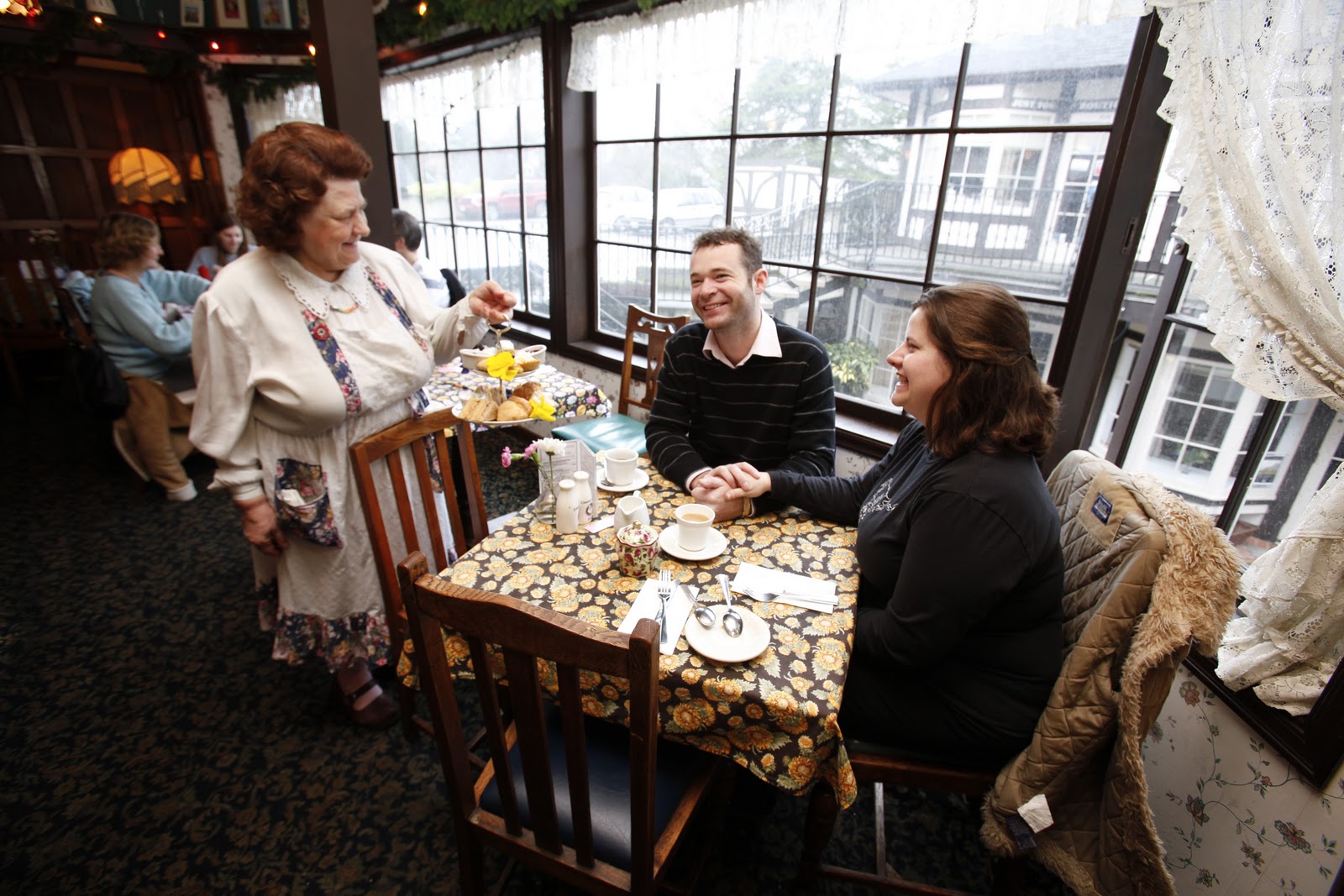
Eating at the Blethering Place was like visiting your dotty aunt for lunch. Photographs by Deddeda Stemler.

By Tom Hawthorn
Special to The Globe and Mail
January 31, 2011

VICTORIA

The Union Jack has been lowered over the Blethering Place Tea Room for the final time.

The banner flew over a landmark restaurant in Oak Bay, a municipality whose borders are teasingly described as the Tweed Curtain.

The Blethering Place, where tour buses stopped and the Galloping Gourmet recorded two episodes of his television cooking program, served its last scone and poured its last cuppa on Sunday.

After three decades of helping convince American tourists that Victoria is an outpost of Merry Olde England, the owner is closing the doors. The city’s “favourite faux Tudor tearoom,” as it has been called, is to be replaced by new owners who have in mind a modern bistro.

“It was an oasis,” said Ken Agate, the 66-year-old proprietor who lives in an apartment above the restaurant overlooking Oak Bay Avenue, the local High Street. “It’s not about being fine dining. It’s about being comfortable and welcome.

“It wouldn’t matter if you sat here all day. You can bring the baby. You don’t need a reservation. You don’t even have to eat.”

The restaurant has been packed this week, as old-time customers returned to sample such dishes as Welsh rarebit, shepherd’s pie, bangers and mash, and a breakfast item billed as “eggs Benedict Arnold.”

While online reviews of the cuisine can kindly be described as mixed, the room earned accolades over the years from travel writers for the Seattle Times (“beloved and venerable”) and the Los Angeles Times (“lots of local ‘old ducks’ chattering away”).

Diners sat in a room filled with such bric-a-brac as dolls and lesson books, toffee tins and biscuit boxes, packaging for blancmange and mushy peas. A portrait of Winston Churchill shared a wall with two Union Jacks.

The decor consisted of “oak panelling, lace curtains, seersucker tablecloths,” the New York Times once noted, while the clientele “look as if they have emerged from the background of an Agatha Christie mystery novel.”

Tea was served in pots covered by crocheted cozies. It was like eating at your dotty aunt’s place.

Mr. Agate bought the restaurant on a whim. He saw the tea room, thought, “I could do that,” and walked in to buy the business. The owner declined, but that very night Mr. Agate got a call from the owner’s wife. Over time, Mr. Agate expanded the space to take over an adjacent grocery and realtor’s office.

He had not been a restaurateur before taking over the tea room, though his family had dairy expertise. Mr. Agate was born in the Fijian coastal village of Navua, where his father introduced ice cream to the tropical archipelago. He grew up in Palmerston North on New Zealand’s North Island, where an early job at a department store led to work as a traveling salesman. He married a hairdresser and eventually owned three salons, which were sold to finance a relocation to Vancouver Island.

He took over the restaurant on the first day of 1981, when, as he puts it, “I got into the beautiful rut of the Blethering Place.”

The tea room took its name from a Scottish word for “voluble senseless talking.”

One day, he spotted among the diners Graham Kerr, the popular cook known by his television audience as the Galloping Gourmet. Mr. Kerr had begun his media career in New Zealand, so the two hit it off, and soon after two episodes for the chef’s syndicated program were taped in the tea room.

The tea room shared a block with such businesses as the Penny Farthing pub and the Tudor Sweet Shoppe, which contribute to the neighbourhood’s sense of British heritage. Yet, Oak Bay’s exclusive Uplands neighbourhood was designed by American landscape architect John Charles Olmsted, while other subdivisions were planned according to principles outlined by American sociologist Clarence Perry.

The Union Jack that once flew over the restaurant, shredded by winter winds, has found a home in Washington state. A vexillologist in the city of Battle Ground, north of Vancouver in Clark County, collects distressed banners. The Union Jack is tattered by weather, not war, an appropriate keepsake for Battle Ground, which takes its name for a site on which an anticipated battle did not take place.

The Blethering Place, where tour buses stopped and where Graham Kerr taped two episodes of The Galloping Gourmet, was a landmark on Oak Bay Avenue.

Wednesday, January 26, 2011

Covering the minors propels a dreamer to the Hall of Fame

The premiere issue of All-America Baseball News was a ragged affair with sloppy layout. But the information was good and the publication, later renamed Baseball America, found an audience.

By Tom Hawthorn
Special to The Globe and Mail
January 26, 2011

VICTORIA

Allan Simpson had a dream. He was going to quit his accountant’s job to start a newspaper about baseball.

Not about the star sluggers, or the most popular teams.

A newspaper about unknown players. Amateurs. Prospects. College kids.

Friends and potential financiers issued a unanimous verdict: You’re going to strike out.

“I ran the idea by everyone and they all thought I was completely nuts,” he recalled on Tuesday. “Except my wife.”

He took the gamble, moving his young family, with two toddlers, from Vernon to White Rock, where he had bought a home with a garage, which would be his office.

Years later, he would look back in amazement at his own judgment.

Allan Simpson
“Here I was, a guy with no publishing background, limited financial resources, few active contacts in baseball,” he once wrote, “trying to launch a national baseball publication out of the garage of my house. In Canada, no less.”

He knew Americans would balk at a baseball periodical from Canada, so a post office box was rented across the border in Bellingham, Wash.

He had a killer name for the publication, too — All-America Baseball News.

It was, he acknowledges, “a little deceitful.”

He built his own angled layout table and bought a primitive typesetting machine that in 1980 was already obsolete.

The office was primitive.

“Unheated,” he recalls. “Had my skis in there. Beer bottles. Winter tires. The works.”

At night, he skimmed out-of-town newspapers looking for nuggets of baseball wisdom. He wore a jacket, though found it difficult to turn pages with gloves on.

Mr. Simpson was an avid and longtime reader of The Sporting News. Known as the "Bible of Baseball,” the newspaper decided in the 1970s to forego coverage of baseball’s minor leagues in favour of articles on professional football and hockey. He’d fill the niche with a tabloid newspaper.

Through direct mail solicitations and a handful of small advertisements in the rival publication, he found a modest audience who shared his obsession with all things baseball. About 1,500 fellow diehards bought his pitch, almost all of them Americans, forked over $16.50 US for a 22-issue charter subscription.

He had no idea what he was getting into.

Mr. Simpson had been born in Kelowna, the grandson of Stanley Merriam Simpson, a sawmill owner whose box company made the crates in which the Okanagan’s rich bounty of fruit was shipped around the world. Young Allan attended a private school where the preferred sports were soccer, badminton and cricket. He did not play baseball until age 15.

He had a summer job as a sportswriter with the Kelowna Courier and covered university sports briefly for the Vancouver Sun until the daily went on strike. He eventually headed north to become the assistant general manager of the Alaska Goldpanners amateur baseball team. When the local newspaper discovered his background, he also became summertime sports editor of the Fairbanks Daily News-Miner.

On his honeymoon, he stopped in Montreal to talk his way into becoming the first general manager of a fledgling farm team in Alberta. The one star on the Lethbridge Expos was a skinny, 20-year-old outfielder from Miami named Andre Dawson. Mr. Simpson earned just $700 a month. He returned to school and became an accountant. Until he had his dream.

The first issue was overdue. He thought he could typeset all 32 pages of articles himself. Strike one.

A friend had to be called in. A day before the pages were to be sent to the printers, long galleys of typeset articles hung from the rafters of the garage like flypaper. He thought he could paste down all the articles in one night. Strike two.

He knew little about design. For the masthead he chose a font that would be more appropriate for Irish Spring soap. Pages were incomplete and riddled with errors, but the presses were ready to roll, so he rushed across the border to the Bellingham Herald. They slapped in some final corrections in a different typeface.

“A classic it was not,” the editor/publisher/typesetter said.

He was so tired after two sleepless nights of production that he didn’t dare drive the 40-kilometres home to bed. He slept in his car at a rest stop on Interstate 5.

The next day he took the premiere edition to Seattle to be mailed.

With horror, he realized he had less than two weeks to produce the second issue.

The publication, later to be renamed Baseball America, nearly died that year, but a strike by major league players fueled an appetite for news from baseball’s lesser circuits. Circulation grew.

Mr. Simpson sold a majority interest in the newspaper two years later, moving with it to Durham, N.C. In time, it became a must-read trade publication. He left the newspaper five years ago to become a vice-president with Perfect Game USA, a prominent baseball scouting service.

Next month will mark the 30th anniversary of the paper’s debut.

On Monday, the Canadian Baseball Hall of Fame at St. Marys, Ont., announced their latest inductees — Tom (The Terminator) Henke, a relief pitcher for the Toronto Blue Jays: George (Dandy) Wood, an 19th-century player from Prince Edward Island; and, Mr. Simpson, 62, a dreamer.